

Courses
(This list of courses may not be up to date. Please see the latest General Catalog for a complete list of current courses.)
ARTH 114. 20th Century European Art & Film (4)
Major styles of the 20th century, including Fauvism, Cubism, Expressionism, Surrealism, etc., and their appearance in the visual arts, theater design, and film will be explored. We will also evaluate how Western European artists borrowed imagery from other cultures and their relationship to colonialist concerns. We will also consider representations of the body and how this imagery relates to gender constructions. The effects of urbanization upon the artistic enterprise and the development of abstract and non-objective art will also be considered. This course satisfies a requirement of Film Studies minor.
ARTH 116. Contemporary World Art 1945-present (4)
This course will explore major artists, styles, and movements in world art from 1945 until the present. These include Abstract Expressionism, Pop, Land Art, Installation, Video, Performance, Feminist, Post Colonial, among others. At least five films will be shown that coincide with the aforementioned developments. Topics such as the use of new materials and media, the impact of popular culture and technology, the effects of censorship, and the relationship between art and gender issues will be discussed. We will explore art in the U.S., Europe, Japan, Africa, Australia, the Middle East, among others. This course satisfies the requirements for the Art History major and minor, the Film Studies major (self-designed) and minor, and the Gender Studies major (self-designed) and minor. There are no prerequisites, although ARTH 007, ARTH 009, or ARTH 114 is helpful.
ARTH 118. Art in the United States: 1865-1945 (4)
This course will explore major painters, sculptors, architects, and film makers in the U.S., 1865-1945. Topics such as depictions of race and immigration, the impact of technology upon visual representation, art and politics, and the impact of gender on art will be discussed. Expatriate art, the Ash Can School, the Stieglitz Group, the New Deal art projects and other significant styles will also be examined.
ARTS 011. Photography I (3)
This course is an introduction to photography's aesthetic and technological history. It is a Black and White photography course composed of three units of study (5 assignments) that develop skills and understandings with cameras and photographic materials within the context modern and post-modern photographic theory and aesthetics. Each assignment is issued through introductory lecture/field demonstrations and completed by the students in the field, studio and darkroom.
ARTS 045. Digital Photography (3)
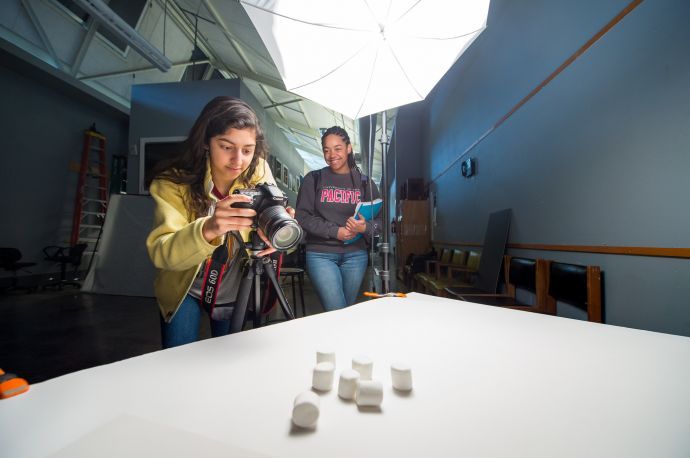
This course provides a foundation for the historical, technical and aesthetics of digitally based photography through a series of applied assignments. Included are practical assignments for working with digital cameras, scanners and a selection of software for image editing and printing.
ARTS 095. Computer Graphic Design II: Time Based Media (3)
This course examines and develops projects using computer-generated imagery and time-based software applications. Applications include, but are not limited to digital video editing, interactive multi-media and the World Wide Web. Prerequisite: ARTS 075 or Instructor's permission.
ARTS 141. Photography II (3)
This is a highly experiential course designed to provide direct, high quality contact with professional resources (human and material) and involve photographers in a selection of assignments exemplary of the larger field of professional photography. This class will undertake four assignments that involve studio visits, extensive fieldwork and in-class activities that provide publication experience through the creation of press-ready and web-ready photographic materials. Prerequisites: ARTS 045.
ARTS 143. Photography III (3)
Designed to provide students with the foundational work necessary for graduate work in photography or entry level positions. Emphasis upon studio management and portfolio development. Prerequisites: ARTS 141.
ASIS 120. Asian Cinemas (4)
How do contemporary films from China, Hong Kong, Taiwan, Japan, Korea, Vietnam and India represent their people, re-imagine their cultural identities, and negotiate the local and global, tradition and modernity? This course is an introduction of Asian cinematic narratives. The focus will be on trying to map the overall picture of each cinema, and then examine their major films. Possible topics include cinematic history of each country; relationships to literary and cultural discourses; different film genres; major directors, and various thematic concerns. The aims of this course are to expand your knowledge of both the broad cinematic and socio-historical contexts of Asian cinemas, as well as to enhance your critical thinking. Lectures and readings in English, all films have English subtitles; no prior background is required.
COMM 131. Media Production (4)
This course covers practical and theoretical application of audio and video production techniques. Emphasis on aesthetic qualities of sight and sound productions. Some work in student media facilities involved. Prerequisite: COMM 031 or permission of the instructor. Lab fee required.
COMM 193. Documentary Film as Persuasive Communication (4)
ENGL 031. Aesthetics of Film (4)
An introduction to the principles of artistic expressiveness of films: lighting, color, camera, composition, space, movement, image, setting and sound. Attention is also given to narrative techniques and editing styles. Explores such theories as realism, formalism, surrealism, Marxism, psychoanalysis and gender theory. Both American and foreign films are viewed and discussed.
ENGL 115. Screenwriting (4)
In this comprehensive course, students study the art and craft of short subject and feature film screenwriting, including, but not limited to: theme, plot, story structure, characterization, format, and dialogue via writing, lecture, discussion, close analysis, and instructor-peer critique. Time will be spent not only on idea generation and visual storytelling, but on how to meaningfully connect with the audience. Students will be required to write: two short film treatments (one original and one adaptation), a short film script, a detailed feature film treatment, and the first 10+ pages of a feature film screenplay.
ENGL 117. Film Production (4)
Students are introduced to the fundamental principles of motion picture production, emphasizing visual storytelling and auditory communication through demonstration, hands-on production and critical analysis. Students produce short films in small crews. Some equipment and materials are provided by the school, but approximately $300 should be budgeted for miscellaneous expenses and lab fees.
ENGL 121. Major Filmmakers (4)
Focus is on the work of such major directors as Coppola, Fassbinder, Scorsese, Fellini, Kubrick, Bergman, Hitchcock, Antonioni, Losey, Bertolucci and Truffaut. The course also considers major schools of cinema: French New Wave, Italian Neo-Realism, New German Cinema, and narrative genres such as the psychological thriller, chamber film and epic. Emphasis is placed on critical analysis and interpretation of the individual director's styles and themes.
ENGL 122. Literature and Psychology (4)
A study of psychoanalytical methods in the interpretation of literary texts through a close investigation of language, narrative, structure, symbol and archetypal patterns. Considers such phenomena as family romance, primal scene, return of the repressed, and the schizophrenic experience as related film to the literary work and the creative process.
ENGL 123. Film, Literature and the Arts (4)
Investigates the theory, practice and critical methods underlying aesthetic form in the arts, including film, literature, painting and sculpture. Corollary illustrations are drawn from music and architecture. This comparative course attempts to examine the underlying styles and structures among the arts.
ENGL 124. Film History (4)
Comprehensive look at the history of cinema, from its beginnings in Europe and America, through the emergence of national cinematic traditions and the classical period tied to the Hollywood studio system, and concluding with current transitional developments. Screening and analysis of significant American and international films.
ENGL 127. Contemporary Critical Issues (4)
Examines major aspects of literary theory from structuralism to post-structuralism. Focuses on the interplay between and among such movements as deconstruction, post-colonialism, the new historicism, phenomenology and psychoanalysis. The course also discusses how contemporary theory has impacted such topics as gender, canon, reader-response and post-modernism.
ENGL 131. Shakespeare (4)
Eight to ten of Shakespeare's plays on film, studied from a variety of critical perspectives, such as the historical, psychological, philosophical, formalist, cultural and theatrical approaches. Selections from each major genre (comedy, tragedy, history). Specific works vary from term to term; the list may include such works as Twelfth Night, The Tempest, King Lear, Macbeth, Richard II, Henry IV (Parts One and Two) and Henry VIII from directors such as Branagh, Welles, and Kurosarva.
ENGL 191. Independent Study (2-4)
Student-initiated projects involving subjects not addressed by current course offerings. In consultation with a faculty director, the student shall submit in writing a proposal which defines the specific subject matter, the goals, the means of accomplishing the goals and the grounds for evaluating the student's work. The proposal must receive the approval of the director of the project prior to registration, and responsibility for fulfilling the terms of the proposal lies with the student.
ENGL 193. Special Topics (4)
Additional courses not covered by regular offerings.
FREN 120. French Cinema (4)
A study of the development of French cinema through the analysis of themes, styles, and cinematic techniques. In French. Films with English subtitles. Offered occasionally in English with no prerequisite. Prerequisite for French version only; FREN 025 or equivalent.
RELI 171. Religion and Cinema (4)
A study of the way religious ideas, institutions and figures are presented on film. The course involves screening and analyzing a variety of films. The scope of the course will be international and intercultural, but the majority of the images will inevitably be Biblical and Western. The course intends to demonstrate the power of cinematic images to define, enrich and sometimes pervert the religious sensibility.
RUSS 120. Contemporary Russian Film (4)
A course designed for a general audience. No knowledge of Russian is required; lectures and readings are entirely in English. All the movies to be screened have English subtitles. This course is an overview of contemporary Russian film as representation and reflection of Russian cultural values and political and economic changes for the 1960s to the present. Students will see and discuss works of major film directors in their social, political, historical, and cultural context. They will learn about new cultural trends, the relationship between culture and officialdom, as well as peculiarities of national self-perception (the Russian Idea), gender/ethnicity based interpretations, and artistic realities in Russian film.
SPAN 114. Cine hispano/Hispanic Film (4)
A study of the development of Latin American or Peninsular cinema through the analysis of themes, styles, and cinematic techniques. Themes might include Latin American women film directors or the films of Pedro Almodóvar, among others. In Spanish. Films in Spanish with English subtitles. Offered occasionally in English.