


The applied mathematics major is designed for students who are interested in applying their mathematics skills to problems in the real world, for example, in engineering. Our students graduate with a passion for mathematics and learning and are able to apply the problem-solving skills learned in the classroom to the world around them. Our mathematics program offers opportunities for you to refine your knowledge and use of mathematics content, communication and teamwork, mathematical reasoning and problem solving, and technology. Courses are intended to give you a competitive edge when you enter the job market.

Students who choose to major in mathematics are provided opportunities to develop strong problem solving skills that use quantitative methods and appropriate technology. They understand the strengths, limitations and wide applicability of mathematical modeling in a variety of disciplines. Students develop an appreciation for the discipline and esthetics of mathematics, effectiveness in problem solving, and an appropriate understanding of theory. Graduates who major in mathematics are prepared for the many careers in which mathematics plays an important role, for further study in Mathematics at the graduate level, or for careers in teaching mathematics.

The first course in all Mathematics majors is Calculus I, II or III depending on the student’s high school preparation in mathematics. Majors with AP Math AB or IB Math HL credit start in Calculus II. Majors with AP Math BC credit start in Calculus III. Students who are not able to start in Calculus I because of deficiencies in their algebra or Trig skills start in MATH 041, Precalculus. Students who place lower than MATH 041 discuss with their advisor how much extra time is required to complete their degree program because of the required developmental work. Mathematics majors are proficient with graphing calculators and consider taking elective courses that use quantitative skills in areas such as business, economics, computer science, science and engineering.

Minimum 46 units and 13 courses that include:

MATH 051Calculus I

4

MATH 053Calculus II

4

MATH 055Calculus III

4

MATH 075Introduction to Linear Algebra

4

MATH 145Applied Linear Algebra

4

COMP 051, or COMP 061Introduction to Computer Science, or Introduction to Programming for Data Science

4

Select one of the following:

4

MATH 049Introduction to Abstract Mathematics 
MATH 057Applied Differential Equations I: ODEs 
Select three of the following (minimum 3 units per course):

9-12

MATH 037Introduction to Statistics and Probability 
MATH 049Introduction to Abstract Mathematics 
MATH 057Applied Differential Equations I: ODEs 
MATH 072Operations Research Models 
MATH 074Discrete and Combinatorial Mathematics 
MATH 110Numerical Analysis 
MATH 121Financial Mathematics I 
MATH 122Financial Mathematics II 
MATH 130Topics in Applied Statistics 
MATH 131Probability and Mathematical Statistics I 
MATH 132Probability and Mathematical Statistics II 
MATH 133Topics in Applied Statistics II 
MATH 148Cryptography 
MATH 152Vector Analysis 
MATH 157Applied Differential Equations II 
MATH 174Graph Theory 
MATH 193Special Topics (to be approved by advisor) 
Three further electives chosen from a list of approved courses available in the mathematics department or math electives numbered MATH 049 or higher (excluding MATH 161, MATH 162, and MATH 166.) At most one elective may be numbered lower than 100.

9-12

Note: 1) Electives are to be chosen in consultation of a major advisor. 2) At most one elective may be numbered lower than 110. 3) One elective may be chosen from the following experiences: independent study, undergraduate research, internship, and practicum.

Contact Us

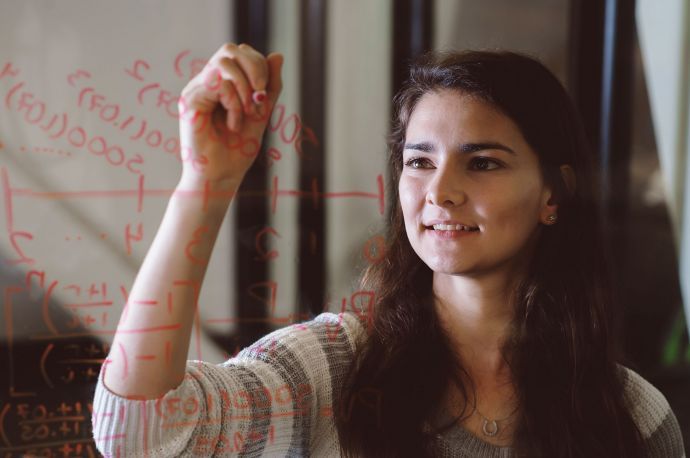
math student writing on glass
Department of Mathematics

College of the Pacific
3601 Pacific Avenue
Stockton, CA 95211