

Breadcrumb
Homeopathic medicines elective puts students on leading edge of pharmacy practice
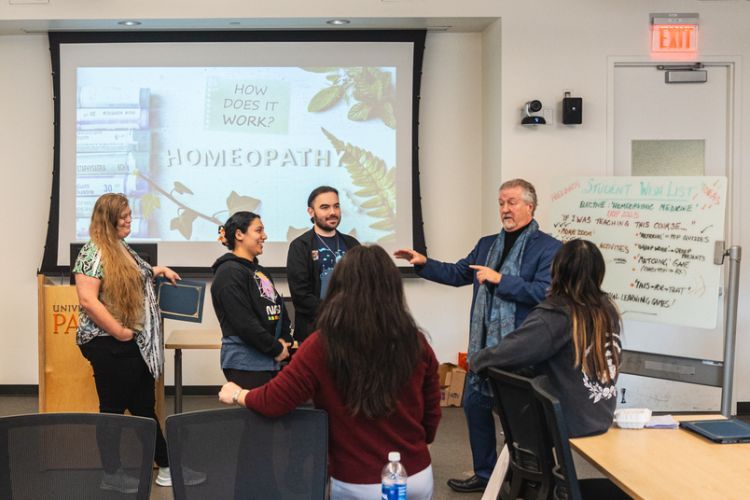
Students in the Thomas J. Long School of Pharmacy attend a homeopathic medicine class.
A patient approaches the pharmacy counter holding Calendula officinalis—a homeopathic remedy made from marigold flowers—and asks if it can help treat a minor burn. Through the Introduction to Homeopathic Medicines elective, University of the Pacific students in the Thomas J. Long School of Pharmacy are ready with an informed answer.
First offered in fall 2024 and led by Professor of Pharmacy Practice Kate M. O’Dell, the elective introduces future pharmacists to a category of products that is growing in popularity. As the most accessible health care professionals, pharmacists are often the first point of contact for patients seeking guidance on medications.
“As future pharmacists, students should be competent in counseling patients on products that are sold in pharmacies, including homeopathic drug products,” O’Dell said. “Pharmacists who are knowledgeable about homeopathic medicines can provide a level of care that is not yet widely adopted in current practice.”

Professor Kate O'Dell instructs students during a homeopathic medicine class.
Homeopathic drug products are readily accessible to consumers, similar to over-the-counter drugs, vitamins and supplements. These products are regulated by the U.S. Food and Drug Administration and must meet the manufacturing and labeling standards of the Homeopathic Pharmacopeia of the United States.
According to one market forecast, the U.S. homeopathic market is projected to grow from $2.4 billion in 2023 to $6.8 billion by 2035.
Herbal supplements are made from plants and work through established biological mechanisms, such as interacting with receptors and enzymes. In contrast, homeopathic drug products are derived from plants, animals or minerals and are prepared through serial dilutions and vigorous shaking, a process called succussion.
Homeopathy is based on two key principles: “like cures like” and microdosing, the idea that very small amounts of a substance can stimulate the body’s healing response.
Examples of homeopathic medicines discussed in the course include Arnica montana for pain and bruising and Anas barbariae for flu-like symptoms.

Shane McCamey, director of training and business development at Boiron USA, serves as a guest lecturer.
“The homeopathy elective course was one of the most eye-opening experiences I have had during pharmacy school,” said Marry Ann Danial ’26, a PharmD student who took the course last year. “It pushed me to look beyond traditional treatment options and really think about how we, as pharmacists, approach patient care holistically. I appreciate how the course encouraged open discussion and curiosity while still grounding everything in scientific evidence.”
The elective was launched through a partnership with Boiron. Founded in 1932, Boiron is the largest global manufacturer of homeopathic drug products, with products distributed to 50 countries.
“We are grateful for the thoughtful engagement and leadership of Shane McCamey, director of training and business development at Boiron USA, for providing valuable support to launch the first, formalized 13-week structured curriculum in homeopathic medicines at a U.S. pharmacy school,” O’Dell said.
The partnership has already inspired student research and national visibility. Five students from the inaugural class presented a poster at the American Society of Health-System Pharmacists Midyear Clinical Meeting in 2024, sharing their findings and demonstrating how Pacific continues to lead innovation in pharmacy education and patient care.
“This experience helped me grow as both a communicator and researcher, and it gave me a deeper appreciation for how integrative approaches can enhance patient outcomes,” Danial said. “Overall, this elective reminded me that good medicine isn’t just about the drug but it’s about understanding the patients and their individual needs.”