

Breadcrumb
Professor takes a deep dive into autonomous vehicles in new paper
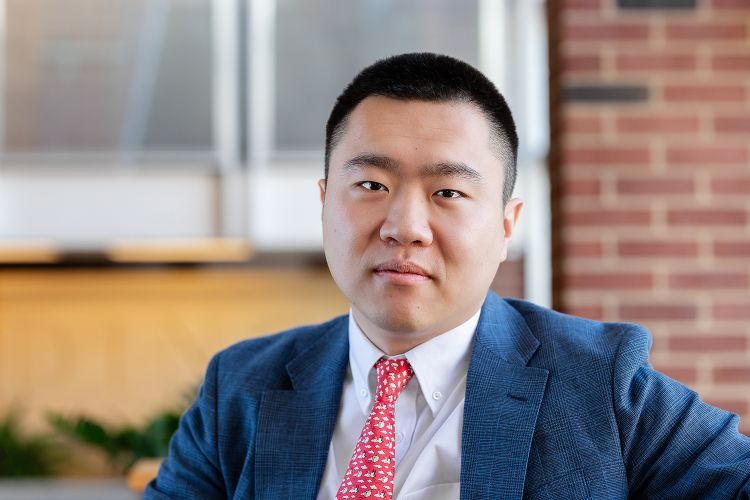
Assistant Professor Jake Gao
Incoming Assistant Professor of Law Jake Gao publishes paper in Santa Clara Law Review
Incoming Assistant Professor Jake Gao recently published his newest paper, Formal Neutrality and Unequal Liability: How Algorithmic Aversion Distorts Liability for Algorithmic Torts, in the Santa Clara Law Review. He will begin teaching at the University of the Pacific McGeorge School of Law on July 1.
During this presentation, Gao discussed how new technologies can be harnessed to enhance the law’s ability to promote social welfare.
Gao’s scholarship primarily focuses on law and technology, emphasizing on new technologies and the law of torts.
He received a PhD from Massachusetts Institute of Technology, a JD degree from Columbia Law School, and a BSE degree from Princeton University. He is interested in exploring how legal institutions can be leveraged or modified to facilitate the adoption of emerging technologies.
“I study transportation planning because I’m interested in how new mobility can improve our lives,” Gao said. “And I studied law. I went to law school in part because I was interested in how we should regulate mobility. And at the intersection of these two areas of interest is a pressing problem. And that is how should the law respond to the emergence of autonomous vehicles?”
Autonomous vehicles include any self-driving vehicles, such as Waymo and Tesla. Gao’s research projects include measuring the impact of algorithmic aversion on the judicial process, describing a process for making algorithmic law that accounts for the interactive effects of individual behavior, and measuring the role of normative motivations for compliance with the law.
In Gao’s discussion, he admits that autonomous vehicles are not perfectly designed, as they still can cause crashes. His research takes place by asking the question of how to regulate this transformative technology that holds so much promise but still carries some level of risk.
When these vehicles crash, Gao calls this an algorithmic tort, which is a tort that happens because of the decision-making of an algorithm.
“The question I'm interested in my paper is whether algorithmic torts should be subject to negligence or product liability,” Gao said. “Now, under the current law, algorithmic torts are subject to product liability, but product liability was developed in a time when the machines were operated by humans, and the harms that the machines caused were largely the consequences of mechanical failures.”
Yet in this day and age of technology, algorithms have been increasingly embedded into machines to operate them in place of humans. Gao continues his research while questioning whether it's still appropriate to subtract our reports from product liability.
In the fall, Gao will teach Torts at McGeorge, diving deeper into these concepts.
Before joining the faculty at McGeorge School of Law, Gao served as a Visiting Assistant Professor of Law and Ribstein Fellow at the University of Illinois Urbana-Champaign, where he taught courses on Behavioral Economics and the Law and Law and Emerging Technology from 2024-2026.