

Breadcrumb
Data science students use AI to improve drug safety
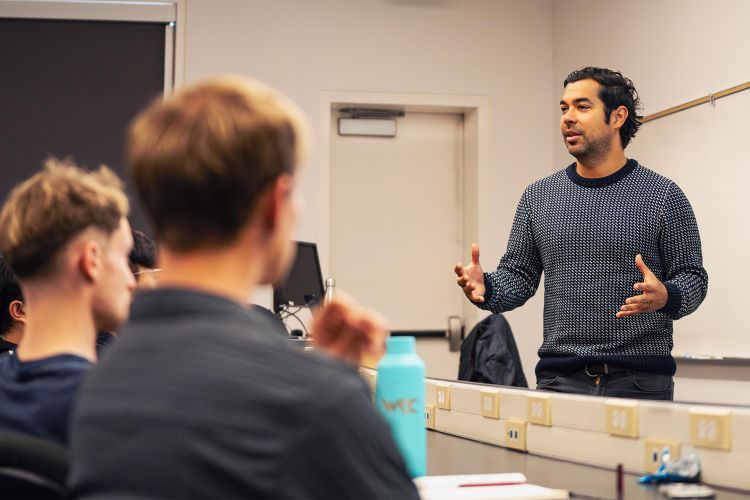
Robert Betancort, chief operating officer of Absentia Labs, speaks to students.
Students in University of the Pacific’s School of Engineering and Computer Science are using artificial intelligence to improve pharmaceutical testing as part of a new partnership with Massachusetts-based Absentia Labs, Inc.
Graduate students in the school’s data science program are working with Absentia’s AI Scientists on computer models that can predict organ toxicity caused by drug candidates—one of the leading causes of late-stage pharmaceutical failures.
Pharmaceutical companies traditionally use animal testing and lab-based experiments to evaluate drugs, but those tests often fail to capture potentially harmful effects in humans. Absentia uses advanced computer modeling to predict harmful effects earlier in the process, which could save years of development and hundreds of millions of dollars.
The collaboration will provide students with portfolio-worthy projects, professional mentorship and exposure to venture-backed startup culture alongside rigorous academic training applied to a real-world industry challenge.
“In the classroom, I teach machine learning theory and techniques, but this partnership gives our students the opportunity to apply machine learning to a challenge with genuine consequences—helping bring safer drugs to patients faster,” said Anahita Zarei, professor of data science and electrical engineering at Pacific. "That's the kind of real-world context that transforms how they understand their work."
Absentia is providing students with curated datawhich they are using to improve machine learning models that can predict whole-human toxicity.
"We're not just providing a dataset for academic exercises," said alumnus Robert Betancort ‘08, chief operating officer of Absentia Labs. "Pacific students will contribute to our active research pipeline, and their work will directly inform our platform development. This partnership validates our data approach while giving students genuine experience with the technical and regulatory challenges of computational drug safety assessment."
Students in the data science program will also collaborate with Pacific’s Thomas J. Long School of Pharmacy, creating interdisciplinary learning opportunities that mirror the increasingly integrated nature of pharmaceutical research and development.
"Exposing our students to problems that cross disciplines is a hallmark of the Pacific education," said James Hetrick, director of Pacific’s graduate data science program. "Our students will leave the master’s program not just with new technical skills, but with a profound experience of addressing real problems and solutions that affect millions of patients worldwide."
The multi-year partnership could expand beyond liver prediction into other critical pathways in the future, providing additional opportunities for students to apply artificial intelligence to pharmaceutical research and regulatory science. It also is helping to build a pipeline of students with the specialized skill set.
"The pharmaceutical industry is rapidly adopting AI and machine learning for drug development, but there's a significant talent gap,” said Rohola Zandie, co-founder and chief technology officer of Absentia Labs. “By working with top-tier programs like Pacific's data science program, we're helping develop the next generation of computational biologists and AI specialists who understand both the technical and domain-specific challenges of this field."
Students began work on the project in January and will present their findings to Pacific faculty and Absentia leadership at the end of the semester.
In addition to its graduate program, Pacific launched an undergraduate major in data science in 2024 to help meet the growing demand for data scientists across industries.