

Breadcrumb
Don DeRosa, transformational leader of Pacific, dies at age 85
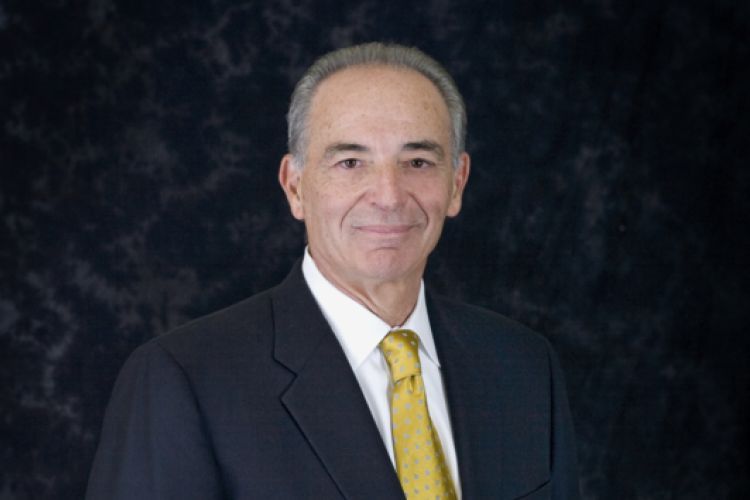
Donald V. DeRosa was the 23rd president of University of the Pacific, serving from 1995 to 2009.
Donald V. DeRosa, the baseball-playing son of New York Italian immigrants and first-generation college graduate who rose to serve for 14 years as the transformational president of University of the Pacific in Northern California, died Wednesday in his Greensboro, N.C., home. He was 85.
DeRosa, the 23rd president of California’s first and oldest university, helped revive and grow a struggling institution into a nationally ranked university, dramatically improving academic rankings, financial stability, fundraising, student success, climate and culture across three campuses in Stockton, Sacramento and San Francisco during his tenure from 1995 to 2009.
In the summer of 1995, the new president inherited a university that had a strong foundation and rich history, but had suffered in recent years from declining enrollments, financial shortfalls, accreditation challenges and low morale. During DeRosa’s tenure, which the Board of Regents described at the time as “transformative” and “historic,” Pacific grew substantially in size, stature and prominence.
“President DeRosa was—by far—one of the most impactful and influential leaders in the 175-year history of this extraordinary university,” said President Christopher Callahan. “Don’s success came from equal parts passion, tireless energy, remarkable intelligence and the innate ability to connect with people—all people—through his distinctive relationship-based style of leadership.
“Any successes at Pacific today are built on the foundation Don DeRosa created,” Callahan said. “On a personal note, Don was a great friend, trusted adviser and inspirational mentor to me. We all will miss him deeply.”
During his presidency, DeRosa emphasized student-centered learning, focusing on the development of the “whole person” through a commitment to rigorous academics, internships and other experience-based learning opportunities, teamwork and leadership principles of social and emotional intelligence. The president also built strong partnerships with the Division of Student Life, which created new and more robust co-curricular and recreational programs to engage students.
Pacific’s enrollment grew by nearly 10% during DeRosa’s presidency, reversing a trend of declining student populations before his arrival.
A first-generation college student who worked throughout high school and attended college on a baseball scholarship, DeRosa was devoted to ensuring Pacific was open to all students, not just those from wealthy families. He successfully expanded the university’s socioeconomic diversity, leaving with an undergraduate student body that was about one-third from lower-income families eligible for Pell and Cal Grants—a significantly higher proportion than similar private schools.
Pacific also physically grew under DeRosa’s leadership. New academic buildings were built across the Stockton Campus, including a Biological Sciences Center, the John T. Chambers Technology Center and the Health Sciences Learning Center.
Furthering his commitment to the development of the “whole person,” DeRosa also led the successful efforts to construct two new apartment-style residential complexes on campus (Monagan Hall and Chan Hall), the Alex and Jeri Vereschagin Alumni House and a 52,000-square foot center for students to gather, share meals and engage in co-curricular activities. In 2008, the Board of Regents named the new student center, which DeRosa called “the campus living room,” the Don and Karen DeRosa University Center in honor of the president and the first lady.
DeRosa was a prodigious fundraiser as well. In 2007, he secured a $100 million estate gift from Robert and Jeannette Powell, at the time one of the largest gifts ever to a university, and one that remains the largest in Pacific’s history. The legacy of the gift continues today through new generations of Powell Scholars and many other scholarships, fellowships, professorships and programs created through a matching program funded by the estate gift. The school’s endowment more than doubled during DeRosa’s tenure.
Increased enrollment and fundraising, coupled with strong financial leadership, put Pacific on a steady financial footing. Annual budget deficits disappeared, a new reserve was steadily built each year and the university’s bond rating improved three times under DeRosa’s presidency.
DeRosa also navigated the university through great challenges, including the Sept. 11, 2001, terrorist attacks on America.
“That was a horrible day for everyone. We gathered with Cabinet and made the decision to bring students together in the Faye Spanos Concert Hall,” DeRosa, who visited each residence hall that night, recalled in a 2021 interview. “On one occasion, I saw a group of Muslim students talking to one another. They were trying to decide whether to have their meeting that night. I encouraged them to hold the meeting and said I would attend. As I spoke, I saw … members of the Hillel Jewish Student Club there. They told me, ‘We came to support our fellow students.’ That told me so much about Pacific.”
Another challenge came at the very start of DeRosa’s presidency. Tiger football had played a critical role—and served as a point of pride—for the university and surrounding community since the move from San Jose to the Central Valley in 1924. But the financial realities of big-time college football led most universities like Pacific to eliminate their programs.
Pacific was no exception, running major operating deficits from football each year. DeRosa and the Regents made the difficult decision to eliminate football, noting that the much larger Stanford University and USC were the only remaining West Coast private universities still playing D-I football in the 1990s.
Still, Tiger Athletics remained a central part of his presidency. Tiger student-athletes enjoyed some of their best years under DeRosa. In 2004 alone, five Pacific teams advanced to the NCAA tournaments—men’s basketball, women’s volleyball, men’s tennis, women’s swimming and softball. And DeRosa, an avid sports fan, created a partnership with the San Francisco 49ers that made Pacific the host of the NFL team’s training camps from 1998 to 2002.
DeRosa also led the construction of some of Pacific’s signature athletics venues, including Klein Family Field, the home of Tigers Baseball, the Intercollegiate Athletic Center, the Douglass M. Eberhardt Aquatics Center and the Janssen-Lagorio Gymnasium for the basketball programs.
DeRosa found other ways also to bring attention to Pacific, developing a strong relationship with jazz great and Pacific alumnus Dave Brubeck, which led to the creation of the Brubeck Institute. And he brought to campus visiting dignitaries such as Brubeck, former President Bill Clinton, actor and director Clint Eastwood, CBS News anchor Walter Cronkite, Nobel Prize-winner Desmond Tutu and California Governor Pete Wilson.
DeRosa attributed much of his success to his leadership team, recruiting top-flight talent who could work together, often despite differences in backgrounds and viewpoints. His senior executive team included Provost Philip Gilbertson, a dean from Valparaiso University, Vice President for Finance Patrick Cavanaugh, a vice president from Drake University, and the late Judy Chambers, a Pacific icon who was vice president for Student Life and later a close adviser.
“He was a great judge of character that led to strong team building,” Gilbertson wrote in an email prior to DeRosa’s passing. “His leadership was based on trust, integrity and teamwork. He was an excellent listener who knew how to build consensus around priorities.”
Gilbertson wrote about DeRosa’s legacy in his history of the university, “Pacific on the Rise: The Story of California’s First University.”
“His success in transforming the university was arguably the most significant in its history second only to (President Robert) Burns,” Gilbertson wrote, comparing DeRosa to the president who served for 25 years and grew Pacific from a liberal arts college into a comprehensive university from 1946 to 1971.
“The comprehensive array of successes was overwhelming in the context of a university that had struggled to find its way for the prior quarter century,” Gilbertson wrote. “DeRosa’s temperament, skills, interests and resolve matched what Pacific needed at the time. ... It is easy to understand why he was revered by the Board and honored by all constituencies as one of Pacific’s great presidents.”
Gilbertson also noted the critical relationships DeRosa built with the Board of Regents, particularly with Robert Monagan, the former speaker of the California State Assembly, a 1942 alumnus, Tiger basketball player and student government president who served as board chair for the majority of DeRosa’s tenure.
“The commanding DeRosa and Monagan partnership … overcame a quarter century of uncertain direction … then moved Pacific ahead with confidence,” the former provost wrote.
Another colleague, former Student Life Vice President Elizabeth Greigo, said that DeRosa “was never just his work. His authenticity, honesty and his genuine caring about the campus and students were ever-present. His interest in every detail. His perception of big-picture issues. His sense of humor. His foresightedness. His ethical insistence. Who he was in the world and how he exercised his leadership at the university had a lasting effect on those who knew him and worked with him.”
In 2009, DeRosa received the annual President’s Award presented by the National Association of Student Personnel Administrators as the outstanding college president most instrumental in advancing student affairs.
He served on the Commission on Leadership and Institutional Advancement of the American Council on Education, the Board of Directors of the Big West Conference, the San Joaquin County Partnership and the Business Council of San Joaquin County.
Prior to joining Pacific, DeRosa was provost and vice chancellor for academic affairs at University of North Carolina at Greensboro. Before becoming provost, he was dean of the Graduate School and associate vice chancellor for research.
DeRosa started his academic career in 1968 as a psychology professor at Bowling Green State University, serving there for 17 years, including as chair of the university’s Department of Psychology. As a professor and researcher, he authored or co-authored over 20 publications on memory, cognition, pedagogy and leadership.
His parents were born in the U.S. but grew up in Italy, returning to the U.S. at ages 16 (father) and 10 (mother) speaking only Italian. They raised their son in the working-class New York City suburb of Eastchester. His father worked as a bank teller and theater manager; his mother was a saleswoman for a clothing store.
An avid New York Yankees fan, he listened to the exploits of his favorite player, fellow Italian American Joe DiMaggio, on the radio since the family did not own a TV. DeRosa worked since he was 13, busing tables, caddying for golfers and delivering mail. After graduating from Eastchester High School, DeRosa enrolled at the American International College in Springfield, Mass., attending on a baseball scholarship as a pitcher.
He graduated from American International with a bachelor’s degree in psychology and a minor in history and earned a master’s degree and Ph.D. in psychology from Kent State University.
DeRosa retired to North Carolina, but kept in close contact with many Pacific professors, leaders, supporters, alumni and friends as president emeritus. He built a close relationship with Callahan, who became the 26th president at Pacific in 2020.
“Don was enormously generous to me with his time, thoughts, patience and advice,” Callahan said. “I was impressed—and dare I say in awe—of his intelligence, passion and amazing memory of all things Pacific. A truly remarkable leader. I feel enormously fortunate to call him a friend and to have learned so much from him. I always looked forward to our early Sunday morning phone calls. He remains an inspiration to me.”
DeRosa is survived by his wife, Karen; their sons, Michael of Brentwood, Calif., and David of Greensboro, N.C.; three children from a previous marriage, Joe of Winston-Salem, N.C., Carol Grabow of Winston-Salem, and Lauren Haarlow of Greensboro; a sister, Eleanor Egger of Portland, Maine; two nieces; nine grandchildren and one great-grandchild.
A celebration of life will be scheduled for the Pacific community at Faye Spanos Concert Hall.