

Breadcrumb
Library serves as a hub for community
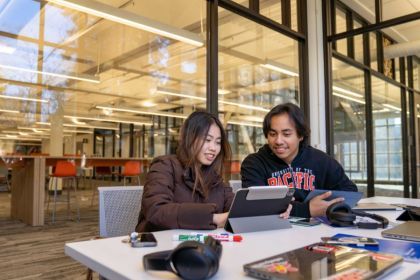
Inside University of the Pacific’s William Knox Holt Memorial Library and Learning Center, an interior window connects a study space with a Starbucks café, creating a shared sense of activity and community. Upstairs, open walkways link spaces for academic support. Just past the entryway, students have access to a creative production space.
The message for students is clear: Come in. Stay awhile. Find your people.
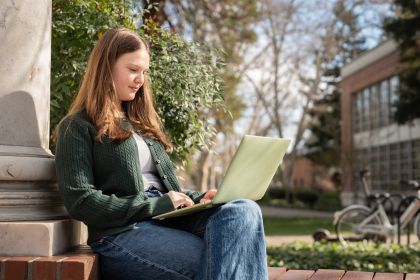
The library is no longer where students go solely to find a book or finish an assignment. It’s become a third space beyond students’ homes or classrooms where they can study, create, connect and recharge.
Designed for how students learn
“The scale, light, openness and energy of the building send a message that learning matters here,” said Niraj Chaudhary, dean of University Libraries and Pacific Global.
It is evident from the way students use the building, that they don’t have to learn alone at Pacific.
When planning for the library’s redesign began in 2016, students, faculty, administrators and staff from across Pacific helped shape what it would become. The renovated building was completed in 2020. Underlying the redesign was a simple idea that learning is social.
“Students can choose what that means for them,” Chaudhary said. “The spaces and services are all found here in the library.”
Students can settle into quiet study areas or meet classmates in collaborative spaces. They can reserve study rooms, grab a coffee or disappear into one of the privacy pods on the second floor, which are often occupied after classes and into the evening. Fifty additional study spaces were recently added on the garden level in response to student feedback.
For pre-dental student Ravleen Brar ’28, the second floor is where her friends can find her at the marble tables.
“I am at the library almost 24/7, sometimes I meet with friends, and all the resources are here. There is printing and extra paper available for notes,” Brar said. “The second floor is a comfort space because I can see outside and I also see others studying, so it’s motivating.”
But studying represents only one way students inhabit the library.
Alongside scholarly databases, eBooks, journals and research consultations are collaborative learning spaces like the Innovation Commons, the Pacific Gaming Center and spaces designed specifically for reflection and belonging.
The result is a campus building where students choose to spend a substantial part of their day.
Vanessa Laoeng ’03, ’27 has been studying at the library since she was an undergraduate student majoring in biological sciences. As a current doctoral student in the physical therapy program, she continues to frequent the space.
“It's a lot better than my dorm or at home because it's not cluttered and it's not a space that I sleep in. This is a space where I know that I'm going to study,” Laoeng said. “And I can eat here, so I get Starbucks. It’s a one stop type of thing. If there wasn’t a Starbucks here, I would be studying at a coffee shop instead.”
During finals, the library stays open around the clock. In the Pacific Gaming Center, students can be found playing and competing into the night, with the space remaining active until 2 a.m.
A place to belong
The rhythm of the building changes throughout the day, but the underlying purpose remains the same: creating places where students can be with one another.
In the Innovation Commons, they can work with 3D printing and fabrication, virtual and extended reality, recording and editing equipment and other technologies. The Cube makerspace expands those possibilities to tools ranging from sewing and vinyl printing to podcasting, 360-degree cameras and augmented reality equipment.
The library also brings faculty into the ecosystem. The Center for Teaching and Learning, Academic Assessment and Academic Technology are housed in the library, providing resources and expertise that support teaching, scholarship and instructional technology.
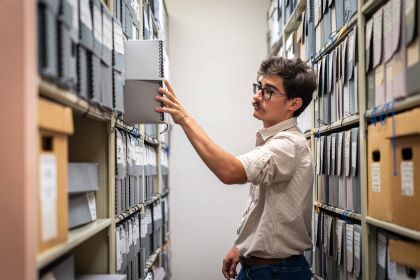
Alongside the technology and collaborative spaces, the library also offers ways for students to connect with Pacific’s history and the wider world. The Holt-Atherton Special Collections and Archives holds primary sources documenting Western Americana, California and Pacific history. The Muir Experience gives students and visitors a chance to explore materials related to naturalist John Muir.
Community, however, doesn’t always mean a crowded table. Sometimes it means having a place to feel seen.
On the second floor, the Rainbow Reading Resource and Study Room offers a leisure-reading collection of LGBTQ+ award-winning literature. Nearby, the Multi-Faith Meditation and Prayer Area provides a quiet place to pray, reflect or meditate, with an ablution station available as well.
Students supporting students
More than 120 students are employed by the library, creating what Chaudhary describes as a “a student community of students serving students.”
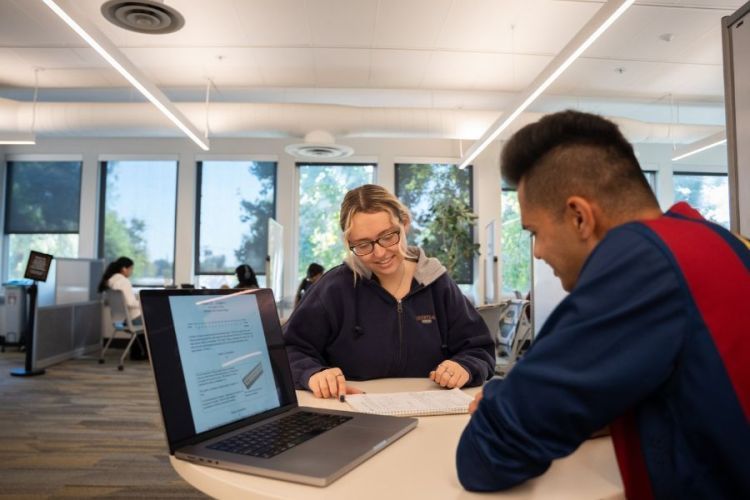
That peer-to-peer model extends into academic support. In the Academic Support Services Hub, students can access peer tutoring, writing support and other academic resources. Brainfuse provides 24/7 supplemental tutoring for students who need help outside traditional hours, while the Writing Center remains available into the evening. Student-athletes have a dedicated study hall, and other services including study-skills development, academic support workshops and support for multilingual learners.
Struggling for an upcoming exam can be stressful and Brar found unexpected help from a fellow student overhearing her study group that was preparing for an upcoming organic chemistry exam.
“I was studying with my sister, and she was trying to help me out with o. chem, because I am a first year and my sister took it the year prior,” Brar said. A fellow student sitting nearby came to help. “She looked over and said, ‘Okay, I can't hear this anymore,’ so she came over, and she helped me out with the next three problems.”
Pacific Global adds another dimension, helping international students and students preparing to study abroad with academic, career, visa and immigration questions.
For Chaudhary, all those pieces come together to redefine the university library. The traditional ingredients of a library exist alongside spaces and services designed for connection, creativity and belonging.
“The library is the academic heart of Pacific,” Chaudhary said. “It is intentionally designed so students can study, create, connect and explore. You can find quiet and solitude, community and collaboration, advanced technology, world class collections and academic support, all under one roof.”