

Breadcrumb
McGeorge School of Law students contribute more than 65,000 hours of pro bono work to community
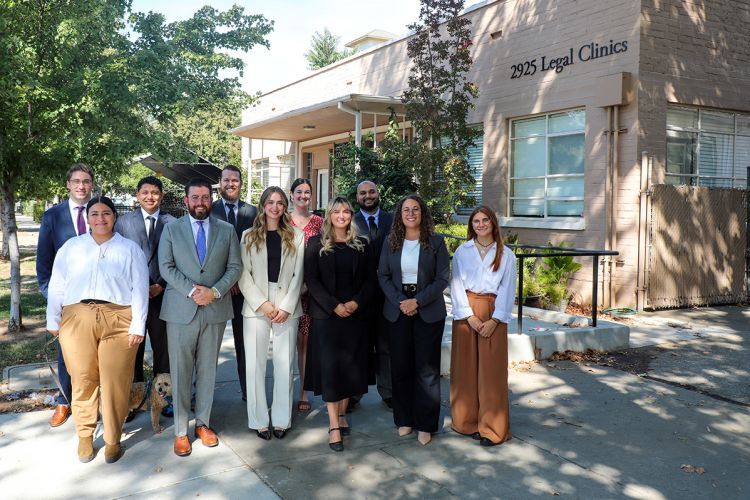
McGeorge students and Professor Ron Hochbaum at Community Legal Services.
McGeorge School of Law students showcased their commitment to public service during the 2024–25 academic year, by contributing more than 65,000 hours of pro bono legal work through the school's externships program and legal clinics.
Students participating in externships spent 51,960 hours serving in various courts, government agencies, and nonprofit organizations. In addition, students contributed 13,640 hours through McGeorge’s legal clinics, including the Bankruptcy Clinic, Elder and Health Law Clinic, Immigration Law Clinic, Buccola Family Homeless Advocacy Clinic, Prisoners Civil Rights Mediation Clinic, Federal Defender Clinic, and Legislative and Public Policy Clinic.
Through these experiential learning opportunities, students gain hands-on legal experience while helping expand access to legal services for communities that need them most.
Colleen Truden ‘04, director of the externships program, said McGeorge students bring valuable skills and fresh perspectives to the organizations where they serve.
“Our student externs bring critical thinking, skill for legal research and writing, client interaction skills and representation in court, and enthusiasm to their work,” Truden said. “They offer fresh views, and their questions help develop the project quality for the legal services provided to clients and community.”
Student externs assist attorneys with research, discovery and other case preparation, helping offices meet deadlines while strengthening the services they provide.
“The memos, discovery and research the student externs contribute aids the attorneys in meeting deadlines, completing work and offering the finest legal work,” Truden said.
While externships connect students with legal organizations throughout the community, McGeorge’s clinics allow students to work directly with clients under faculty supervision. These clinics give students the opportunity to handle real legal matters while developing the professional skills needed for practice.
For many law students, those experiences can be both challenging yet rewarding.
Cassandra Tubiello ‘27, a student in the Buccola Family Homeless Advocacy Clinic, said appearing in court for the first time brought a mix of nerves and excitement.
“I was terrified, as this was my first time arguing in court like this,” Tubiello said. “At the same time, I was excited and grateful to be there.”
Tubiello said the experience was invaluable and reinforced the importance of developing practical litigation skills early in a legal career.
“As a law student who is planning on going into some sort of public interest law in the future, I know how essential oral argument and trial preparation skills are,” she said. “This was a good way to rip the band aid off and start getting comfortable with appearing in court.”
The fast-paced nature of clinic work also pushed students to strengthen skills beyond legal analysis.
“Ash [De La Rosa] and I only had about six days to prepare for this trial, so my soft skills like time management, collaboration, and communication were really put to the test,” Tubiello said.
For Tubiello, the opportunity to represent clients is one of the most meaningful parts of the experience.
“It means so much to represent my clients in cases that impact their lives more than I could ever imagine,” she said. “Not everyone gets the opportunity to go to law school and earn a JD, so I want to use mine to help the people who need it most.”
Ash De La Rosa ‘27, who also participated in the Buccola Family Homeless Advocacy Clinic, said the program gave her a chance to use their legal education to support individuals experiencing homelessness.
“I applied for the clinic because I was tired of feeling helpless every time I saw someone who was unhoused,” De La Rosa said. “This clinic gave me the opportunity to apply my legal education and do something about it.”
Working directly with clients changed her understanding of the role lawyers play in the community.
“My perception of a lawyer’s role has changed drastically,” De La Rosa said. “This community is significantly vulnerable, and legal advocacy is vital for their survival.”
Experiences like these reflect McGeorge’s longstanding emphasis on experiential learning and public service. By combining classroom instruction with real-world legal work, students not only develop the skills they need for their future careers but also help strengthen access to justice in the communities they serve.