

Breadcrumb
NIH grant to support Pacific research on exercise’s role in preventing diabetes complications
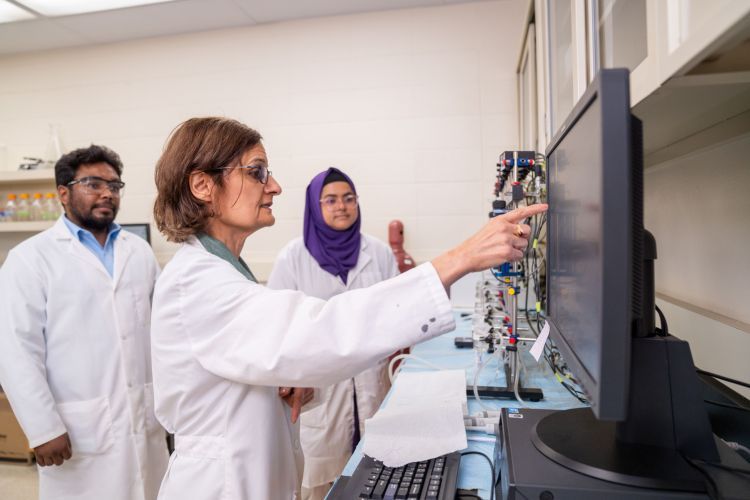
Thomas J. Long School of Pharmacy Professor Roshanak Rahimian
As rates of Type 2 diabetes continue to climb nationwide, University of the Pacific Thomas J. Long School of Pharmacy Professor Roshanak Rahimian is investigating how exercise may protect blood vessels and improve metabolic health during the progression from prediabetes to Type 2 diabetes.
A new four-year, $526,590 grant from the National Institute of General Medical Sciences, part of the National Institutes of Health, may help her find the answer. Rahimian’s research will explore how different exercise intensities may help prevent or reduce the vascular complication of diabetes and whether those effects differ between males and females.
The research builds on Rahimian's previous NIH-funded work investigating sex differences in blood vessel dysfunction associated with Type 2 diabetes. While diabetes is often viewed as a metabolic disease, it is also a leading contributor to cardiovascular problems.
"Many complications begin during the prediabetic stage," Rahimian said. "If we can better understand how exercise protects blood vessels early in the disease process, we may be able to identify better prevention strategies and reduce the risk of long-term cardiovascular complications."
Rahimian's team will investigate the biological mechanisms through which physical activity to protect blood vessels, while examining whether exercise intensity and biological sex influence those protective effects.
These questions are increasingly important as researchers continue to investigate how diabetes-related vascular complications differ between males and females. Sex hormones and other biological pathways may affect inflammation, oxidative stress and metabolic regulation, potentially influencing how people respond to exercise treatments.
By identifying these effects, Rahimian and her co-investigator, Atefeh Rabiee, an associate professor at Pacific, hope their findings will ultimately inform future approaches to reducing the risk of cardiovascular disease associated with diabetes.
For Rahimian, the grant also represents years of collaborative work and creates new opportunities for the next generation of researchers.
“I am grateful to my co-investigator, Dr. Rabiee, for her invaluable collaboration and contributions to this project. I also appreciate my former and current students, collaborators, the Office of Sponsored Programs, and the Thomas J. Long School of Pharmacy for their support throughout the development of this proposal. I am deeply grateful to the NIH for supporting this work.
"This award means so much to us, not only because of the support it provides for our bright students and our research, but also because it reinforces that the science we believe in is strong, meaningful and relevant to human health," she said.
Student training is a central component of the project. Throughout the four-year project period, Pacific students will gain hands-on experience conducting biomedical research, learning laboratory techniques, analyzing data, presenting their findings, and contributing to scientific publications. Those experiences can provide a foundation for careers in science, health care and academic research.
"Working with Dr. Rahimian is an incredible opportunity to contribute to innovative research in vascular physiology and metabolic health,” said Mohammad Moshiur Rahman ’26. “As a graduate student, investigating how exercise improves vascular function in prediabetes and diabetes provides hands-on experience that will help inform future clinical therapies."
As the project moves forward, Rahimian hopes its impact will extend beyond the laboratory.
"I hope this work helps us better understand how exercise protects blood vessels and metabolic function during the progression from prediabetes to diabetes," she said. "In the long term, our findings may contribute to improved prevention strategies and new therapeutic approaches aimed at reducing cardiovascular complications associated with Type 2 diabetes."