

Breadcrumb
Students make life-saving impact through stem cell and bone marrow donation initiatives
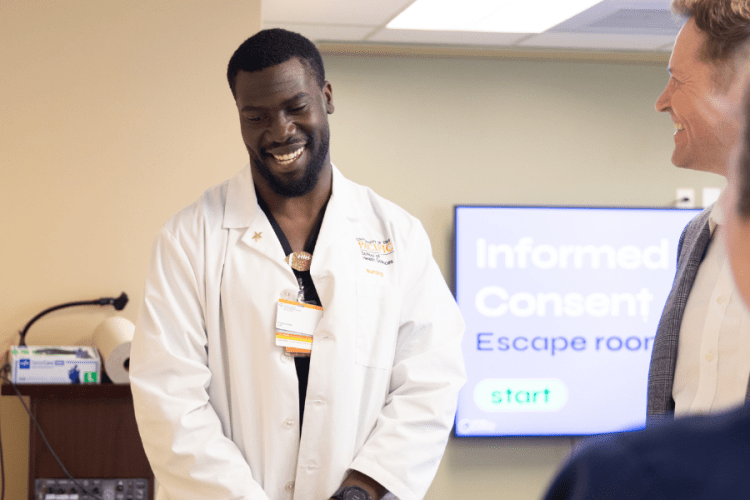
Adeleke Fashola ’26
Just weeks after joining a stem cell donor registry during a guest lecture, Master of Science in Nursing student Adeleke Fashola ’26 received an unexpected phone call: He was a match.
June 9, he boarded a flight to Seattle to donate stem cells to a young boy he had never met.
The opportunity was made possible as a result of recent initiatives in the School of Health Sciences and Thomas J. Long School of Pharmacy to educate students and community members about stem cell and bone marrow donations.
‘The smallest actions can have a profound impact’
For Fashola, the opportunity began earlier this spring when Assistant Clinical Professor Lyndsay Anderson invited a representative from the National Marrow Donor Program to speak with students about the critical need for stem cell donors and the role students will one day play in connecting patients with lifesaving resources.
Following the presentation, students were invited to have cheek swabbed to see if they were a match for any patients needing donations. Seven weeks later, Fashola received a call informing him he was a match.
Despite balancing the demands of his busy clinical preceptorship and finals, Fashola knew he was making the right choice to travel out of state for the donation.
“I may not ever meet him, but I didn't do this to meet him. I did it because I feel like it was the right thing to do,” Fashola said. “When the National Marrow Donor Program called asking if I was willing to do the donation, I didn't hesitate, I just said yes, because I didn't even think about saying no.”
The presentation also opened his eyes to the higher need for donors of diverse ethnic backgrounds. Genetic matching is often linked to ancestry, and patients from underrepresented communities can face greater challenges finding compatible donors. Fashola wanted to help bridge that gap.
“There are people out there with different ethnic backgrounds who are still looking for donors and looking for help, but the donor registry is a lot of people who don't come from different ethnic backgrounds. It was very eye-opening. I am Nigerian, and they said that the person I matched with was most likely the same ethnicity as I am,” Fashola said.
The donation process required him to travel to Seattle, where he underwent peripheral blood stem cell donation, a non-surgical, outpatient procedure done through an IV.
The process is one of two methods used to collect blood-forming cells for a life-saving transplant.
Blood is drawn from one arm, passed through a machine that collects blood stem cells, and returned to the body through the other arm. This process is similar to donating plasma or platelets.
Most donations take 4-8 hours and are completed in one session. About 90% of donors provide blood stem cells through peripheral blood stem cell donation, the other 10% is through bone marrow donation.
Anderson said the donation encapsulates who Fashola is as a student.
“Throughout this course, Adeleke has shown empathy and he has a big heart and curiosity to learn. When he heard about the opportunity to donate, he truly felt blessed to be able to help,” she said.
The experience also reflects the School of Health Sciences’ commitment to community engagement and service. Exposing students to organizations like the National Marrow Donor program helps future nurses be better equipped to connect patients with resources that change lives.
“When I really think about it, it’s just about doing the right thing…My parents always taught my brothers and I that it is harder to be mean than it is to be nice. This journey has been both humbling and inspiring. It served as a powerful reminder that even the smallest actions can have a profound impact on another person’s life,” Fashola said.
‘This drive wasn’t the end… it’s the beginning’
At the Thomas J. Long School of Pharmacy, more than 100 people registered for the National Marrow Donor Program during recent registration drive on the Stockton Campus.
The drive was held in honor of Corinne Stackpole, the 22-year-old daughter of Charlotte Stackpole, associate director for student, parent and family engagement and Mark Stackpole, director of the Office of Academic Success and Instructional Support. Corinne died in March 2026.
“This event speaks to what Pacific is about. When something like this happens, we come together and we support one another,” said pharmacy student Gurinderpal Johal ’27 who spearheaded the event. “That goes from all the way up to the administration of the school all the way down to us students,” he said.
The first 30 minutes of the drive saw 40 people added to the registry, breaking the National Marrow Donation Program’s usual expected rate of 10 registrations per hour. Participants also got a special-edition sticker custom-made in memory of Stackpole.
The drive, Johal said, is just the beginning. Plans are underway to include the National Marrow Donation Program at WelcomeFest in the fall and to organize a larger drive in the future.
“The Stackpoles are very important figures here at Pacific, and about a month after Corinne’s passing, they were still here supporting students and working to make sure students were okay,” Johal said.
“We want to do more events in honor of Corinne, and the National Marrow Donation Program is very willing to come back and partner with us. This drive wasn't the end or just a one-off, it's the beginning.”