

Breadcrumb
Summer Scholars Symposium showcases student research
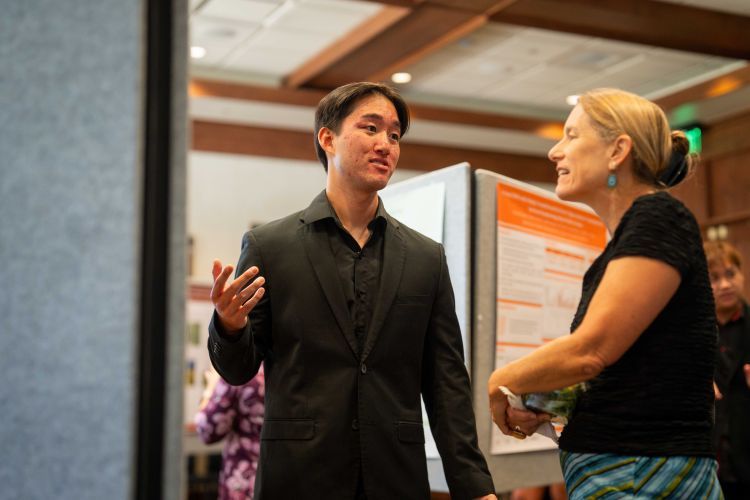
A student shares his research with College of the Pacific Dean Lee Skinner.
From exploring how exercise can be used as medicine to examining the effects of plastic pollutants and artificial intelligence, University of the Pacific students spent the summer researching topics across a wide range of disciplines.
They shared their findings from nearly 30 projects during the Summer Scholars Symposium Aug. 18, an annual event that celebrates research conducted by undergraduates in collaboration with faculty mentors.
“Summer undergraduate research gives our students the time and space to really dive into a question that interests them while working alongside a faculty mentor,” said Gretchen Edwalds-Gilbert, provost and executive vice president for Academic Affairs. “They come back to the classroom with a deeper understanding of their field, but also with the confidence that comes from having done meaningful work of their own.”
Students received support for their work through the Summer Undergraduate Research Fellowship program, which benefits from the generosity of the Fletcher Jones Foundation, as well as through Dreyfus and Stauffer endowments and other generous Pacific donors.
The power of music
Music therapy major Audrey Ewing ’27 presented research on the impact of amplified cardiopulmonary recordings, a music therapy intervention that blends a patient's recorded heartbeat with meaningful music to create a personalized audio legacy.
The method is traditionally used with patients at the end of life. Ewing wanted to explore whether the intervention could have value in another setting.
After learning about amplified cardiopulmonary recordings in a spring 2026 course, Ewing spent a month living with her grandmother and conducting a four-week analysis.
Using interviews and quantitative measures before and after the intervention, Ewing found increases in her grandmother's reported life satisfaction and sense of social connectedness.
The project also gave Ewing an opportunity to better understand her grandmother's experiences and memories.
“This project in particular was very special because I got to spend time with my grandma,” Ewing said. “I haven't typically gotten to see her too much because she's far away, so I lived with her for a month while doing that. It was a really special time for both of us.”
Ewing said music helped create connections that might not have been possible through other forms of communication.
“Music just has a certain way about it that reaches a lot of different people,” Ewing said. “It kind of breaks the boundaries of other ways of connection.”
Eric Waldon, program director for music therapy, said research can be especially meaningful when students pursue questions that connect to something they are passionate about.
“With research, the question for a student is: ‘What do you want to get smarter about?’” Waldon said. “You're already smart, but what do you want to get smarter about?”
He said Ewing's project also demonstrated music's ability to help people learn about themselves and one another.
“Music is a specialized way of knowing,” Waldon said. “You learn more about her through the music that she listened to, the memories that were invoked by the songs and the stories that came from those experiences.”
AI’s impact on academics
Another research project examined one of the most pressing questions facing higher education: how artificial intelligence is changing the classroom.
Cameron Davila ’28, a sociology major, presented her work focused on student-teacher relations in the age of artificial intelligence.
Davila conducted exploratory qualitative focus groups with faculty and students to examine perceptions surrounding AI use and detection in academic settings. The study was designed to identify emerging themes and questions for future research.
Among the themes explored were human intellectual responsibility, context-dependent acceptability and surveillance/enforcement.
Participants discussed the importance of maintaining authorship, critical thinking and human involvement in academic work while also recognizing that some uses of AI may be acceptable depending on the purpose of an assignment.
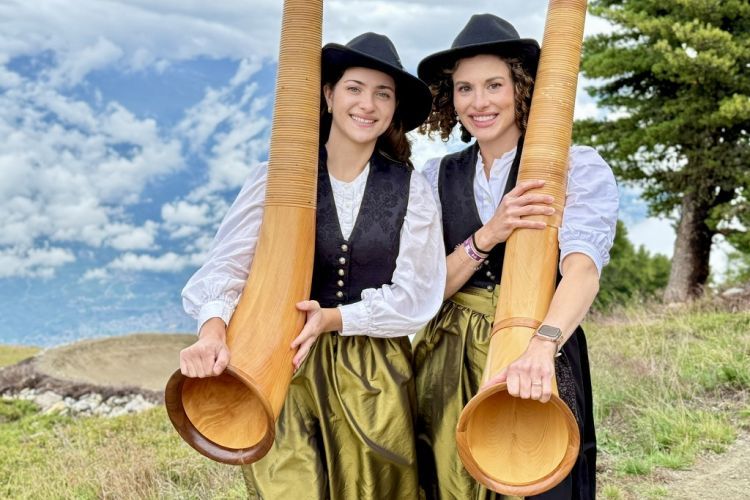
Ciera Alkhoury ’29 and Professor Sadie Glass travelled to Switzerland to compete in an international alphorn festival.
Brass performance and pedagogy
Ciera Alkhoury ’29 attended the Summer Scholars Symposium not only to present her research, but also to perform it.
Alkhoury spent the summer investigating how the alphorn, a traditional Swiss instrument, can strengthen skills used in modern brass performance and pedagogy. Her research took her across the United States and ultimately to Switzerland, where she studied the instrument’s cultural traditions and regional playing styles. Her grew out of Pacific’s participation in the national Alphorn Project.
The traditional Swiss instrument, which dates to the 14th century, produces sound solely through open harmonic tones. Without valves or slides, performers must rely on precise lip control, breath support and advanced listening skills.
“Different universities across the nation have started using the alphorn in brass studios and horn studios as a more modern pedagogical brass tool,” Alkhoury said. “My research project looked at how the alphorn helps to develop those skills in modern brass playing.”
She traveled with faculty mentor and alphorn ambassador Professor Sadie Glass to Switzerland, where she competed at an international alphorn festival, met instrument makers and performed during Swiss National Day events.
The trip also gave Alkhoury a deeper understanding of traditions that cannot always be learned in a classroom.
“Many of the traditions surrounding alphorn are oral traditions, so you have to be there to really pick them up,” she said. “Throughout the different regions, there are different playing styles and different alphorn groups actually have different rules.”
Pacific’s Brass Department has incorporated alphorns into lessons and studio classes as part of the Alphorn Project. In January, six students performed as the Pacific Alphorn Ensemble at the Southwest Horn Conference in Orem, Utah.
For Alkhoury, the research demonstrated the potential of the historical instrument as both a training tool and a cultural tradition worth preserving.
“When this traditional, historical instrument is brought into university settings, there’s a responsibility to protect against its institutionalization,” she said. “It always should be learned about holistically.”
Pacific’s summer research opportunities give students the chance to dive deeply into their fields and explore their passions–a skill that will serve them well in their futures.
“Immersive, full-time research experience is a high-impact practice that prepares students for academics at Pacific, as well as life after Pacific,” said Zachary Stahlschmidt, director of undergraduate research. “This event grows every year, and it’s such an amazing way to celebrate the hard work and creativity of student-faculty research teams.”
Learn more about undergraduate research at Pacific.
To learn about opportunities to support undergraduate research at Pacific, contact Vice President for Development and Alumni Relations Scott Biedermann '05, '20 at 209.946.2166 or sbiedermann@pacific.edu.