Introduction
Upper respiratory tract infections (URTIs) are the leading cause of acute disease worldwide and bear a substantial burden on healthcare systems.1 In the U.S., adults can expect an average of two to four non-influenza-related viral respiratory infections per year, resulting in approximately 75 million physician visits and nearly 150 million lost workdays annually.2 Additionally, ambulatory care visits account for 58.1% of URTI-related expenditures and emergency department visits add another 21.7%.3 Total U.S. spending across all respiratory diseases reaches an estimated $170.8 billion annually, and the cost to employers was approximately $112 billion per year from combined direct medical costs and lost productivity.3,4 The impact affects children at a disproportionate rate, with those under two years of age experiencing the highest rate of URTI episodes of any age group, underscoring the vulnerability of the pediatric population.1 Given the expense and time demands of physician office visits, patients often seek self-care for URTI symptoms. Community pharmacy professionals have the opportunity to serve as first-line providers for these illnesses.5 Homeopathic products for cold, flu, and respiratory symptoms continue to gain popularity among consumers seeking complementary and alternative self-care options. According to a recent projection report, the homeopathy global market is expected to increase from $15.96 billion in 2025 to $28.81 billion by 2034, reflecting a 6.78% annual growth rate over the next decade.6
Because homeopathic medicines are sold as nonprescription over-the-counter (OTC) self-care products, pharmacy professionals should be prepared to address questions and educate patients on the appropriateness of use and the safety of homeopathic drug products (HDPs).7 Despite this widespread availability, survey data indicates that knowledge of homeopathy among pharmacy practitioners remains limited. In a survey of pharmacy graduates, pharmacists who completed a complementary and integrative health elective reported a significantly greater comfort in answering patient questions than their untrained peers (82% vs. 44%, p<0.001).8 A 2024 national study of U.S. pharmacy faculty found support for pharmacists being knowledgeable about homeopathic medicines in order to effectively counsel patients.9
This continuing education activity examines the role of homeopathy in the management of URTI-related illnesses, with emphasis on key counseling points needed to address frequently asked questions about homeopathic products and effectively educate patients on their appropriate and safe use.
History of Homeopathy
Samuel Hahnemann is credited with discovering homeopathy in 1790. Hahnemann was a German physician who became disillusioned with the medical practices of his era and turned to translating scientific work. While working on a text by Scottish physician William Cullen, Hahnemann was skeptical of Cullen’s explanation for the Cinchona bark’s mechanism of action, which was then widely used to treat malaria. To test his hypothesis, he self-experimented with the substance. Upon ingestion, he developed malaria-like symptoms such as fever, chills, and fatigue. From this experience, Hahnemann observed that a substance capable of inducing specific symptoms in a healthy individual might also alleviate similar symptoms in someone who is ill. This concept became one of the main principles of homeopathy, known as the Law of Similars, expressed in Latin as similia similibus curentur, or “let like be cured by like.”10,11 In continuing his work, Hahnemann also observed that when the substance was taken at conventional doses, symptoms often temporarily intensified before relief occurred. Through further experimentation with progressively reduced doses, he found that the worsened effect could be minimized while still preserving the beneficial effects; this concept gave rise to the second principle in homeopathy, the Law of Minimum Dose. Hahnemann later refined the approach through potentization, a process involving serial dilution paired with vigorous shaking, which was believed to activate the body’s natural healing potential.10
Together, the Law of Similars and the Law of Minimum Dose form the notion that a substance which produces symptoms in a healthy individual, when administered in highly diluted amounts, can treat those same symptoms in a person who is sick.10
Overview of Homeopathy
Homeopathy is categorized as a complementary and alternative medicine (CAM) by the National Center for Complementary and Integrative Health, alongside mind-body therapies and natural products. Mind-body practices include meditation, hypnosis, yoga, and tai chi, among others, while natural products include dietary supplements, herbals, vitamins, and probiotics.12 Because homeopathic medicines fall under CAM, they are often confused with herbal products; however, homeopathic products are regulated as OTC drugs in the United States, while herbals and other dietary supplements are regulated as food. Homeopathic product labels must list the active ingredients, potency, indications, and the “Homeopathic” designation, and they may include limited therapeutic claims, while supplement labels are restricted to structure/function claims only and cannot claim to diagnose, treat, cure, or prevent disease.12,13
Manufacturing Homeopathic Products
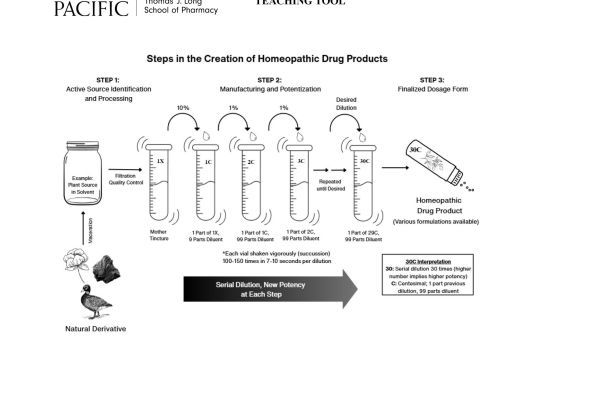
Homeopathic preparations are sourced from plants, minerals, and animal-derived ingredients. These raw materials are initially processed into a mother tincture, the original extract from which successive dilutions are made to create various homeopathic potencies. Each dilution is followed by a vigorous shaking technique called succussion. Succussion is considered essential for activating the body’s innate healing response.10,11 Unlike conventional drugs which are measured in mass or concentration, homeopathic medicines are measured by established dilution or potency scales, the most common being Hahnemann’s Decimal (X) and Centesimal (C), diluted at ratios of 1:10 and 1:100, respectively.10 There are two common preparation methods: the Hahnemannian (H) and Korsakovian (K) methods. Both use the same 1:100 dilution ratio when preparing a Centesimal dilution, but they differ in technique. The Hahnemannian method uses a new vessel at each dilution step and is labeled “CH,” whereas the Korsakovian method reuses the same vessel for each subsequent dilution and is labeled “CK.”14
Homeopathic medicines are accordingly grouped into low (e.g. 6C), medium (e.g. 12C), and high (e.g. 30C) dilutions. Low homeopathic dilutions are typically used for localized, early onset symptoms with frequent dosing, medium dilutions utilized for symptoms that affect entire body as the illness progresses, and high dilutions reserved for complex or chronic conditions with less frequent dosing.14
Figure 1 illustrates the steps involved in the making of a plant-derived homeopathic drug product.
Regulations of Homeopathic Drug Products
Homeopathic medicines are defined as drugs under the Federal Food, Drug, and Cosmetic Act of 1938.13 Therefore, homeopathic drug products (HDPs) are regulated by the U.S. Food and Drug Administration (FDA), with the Homeopathic Pharmacopoeia of the United States (HPUS) serving as the standard guide for identity, potency, quality, and purity.15,16 HDPs must also comply with Federal Trade Commission (FTC) guidelines for truthful and evidence-supported advertising. Product labeling must follow standard drug-labeling conventions and in addition must carry the disclaimer that any stated indications are grounded in traditional homeopathic practice and have not undergone formal FDA evaluation.17,18
Upper Respiratory Tract Infection Classification and Management
URTIs are typically classified based on the affected anatomical region, such as the sinuses, pharynx, or larynx, and based on their underlying etiology, most commonly viral but may also be bacterial in origin.19 The pathophysiology of URTIs involves a host-mediated inflammatory response to infectious pathogens, resulting in both localized and systemic manifestations.190 These infections present with clinical symptoms of nasal congestion, cough, localized pain associated with sinusitis, pharyngitis, or laryngitis, and fatigue, which are mostly self-limiting but can still impair physical functioning and quality of life.19
Current clinical guidelines from the Centers for Disease Control and Prevention (CDC) and the American Academy of Family Physicians (AAFP) emphasize supportive care as the cornerstone of management for acute URTIs.20,21 Recommended treatments include analgesics, such as acetaminophen or nonsteroidal anti-inflammatory drugs (NSAIDs), for the management of fever and pain. Adjunctive therapies, such as decongestants and antitussives, may be used for congestion and cough but should be used with caution due to potential adverse effects, including tachycardia and sedation.20,21 Additionally, antibiotics are not recommended for viral URITs due to their lack of efficacy and the associated risk of promoting antimicrobial resistance.22 Although conventional treatments generally provide symptomatic relief, associated adverse effects and drug interactions have contributed to a rising interest in CAM approaches.
Homeopathy in Upper Respiratory Tract Infection Care
Selection of Homeopathic Medicines23,24
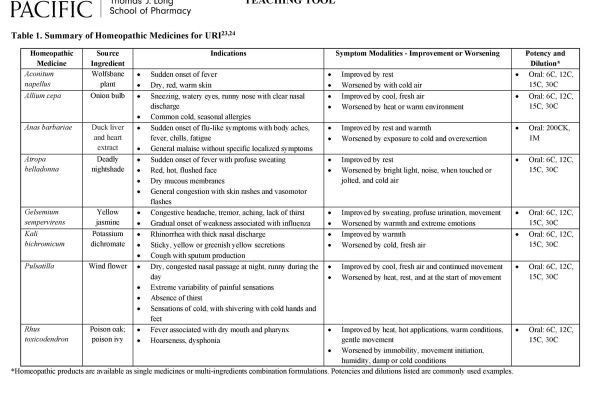
Several homeopathic medicines are available as complementary therapies for URTI symptoms, including but not limited to Aconitum napellus, Allium cepa, Anas barbariae, Atropa belladonna, Gelsemium sempervirens, Kali bichromicum, Pulsatilla, and Rhus toxicodendron. Although each of these homeopathic medicines may be considered for URTI-related symptoms, individualized selection depends on patient-specific characteristics and associated symptoms.
Aconitum napellus, sourced from the wolfsbane plant, is indicated at the first signs of URTI, cold or flu symptoms, especially sudden fever onset. The symptoms appear abruptly, worsen with cold air exposure, and improve with rest. Aconitum is best suited to the first 24 hours of an URTI, before clinical symptoms fully manifest.
Allium cepa, produced from the onion bulb, is indicated for inflamed mucous membranes marked by frequent sneezing followed by profuse, watery discharge that burns and irritates the upper lip and edges of the nostrils. Symptoms may be accompanied by a spasmodic, hoarse cough. Symptoms may worsen in heat or warm rooms and improve with coolness and open air. Allium cepais a frequent choice for inflammation triggered by both viral illness and airborne allergens.
Anas barbariae, made from duck liver and heart extract, is indicated in flu-like illness, particularly at the onset of URTI symptoms. These signs are typically associated with a sudden onset of fever, chills, body aches, and fatigue. Symptoms can be aggravated by exposure to cold or overexertion and improved by rest, warmth, and early medicine administration.
Atropa belladonna, derived from the deadly nightshade plant, is typically used for symptoms associated with the common cold such as sore throat and dry cough. Symptoms typically appear abruptly, often with dilated pupils, flushed face with throbbing headache, dry mucous membranes, and are characteristically worsened by bright light, noise, or jarring motion and improved by rest.
Gelsemium sempervirens, prepared from the root of yellow jasmine, is indicated for febrile states that are characterized by extreme weakness associated with influenza, head congestion, dull headaches, and lack of thirst. The gradual onset of symptoms contrasts with the abrupt onset and intensity of symptoms associated with Aconitum and Belladonna.
Kali bichromicum, sourced from potassium dichromate, is used for cough with sputum and mucosal inflammation that produces thick, sticky, stringy secretions. Pain and pressure at the base of the nose typically start and stop suddenly or shift erratically. Symptoms are worsened by cold air and improved by warmth.
Pulsatilla, prepared from the wind flower, is used in inflammatory conditions of the mucous membranes producing a discharge that is yellow or greenish yellow, bland, and non-irritating. General absence of thirst and extreme variability of painful sensations are associated with the use of this medicine. Nasal passage is dry and congested at night but runny during the day.
Rhus toxicodendron, derived from poison ivy, is used in febrile syndromes marked by lethargy with restless agitation, often accompanied by a dry cough. Over the course of febrile episodes, patients may experience dryness of the mouth, pharynx, and tongue, the latter of which can be covered by a brown or whitish coating, with a pronounced thirst. Symptoms may be aggravated by humidity and excessive tiredness but improved by heat and hot applications.
Individualized Homeopathic Medicines
Homeopathic prescribing is guided by one of two approaches, individualized (IHM) or non-individualized (non-IHM) medicine. The IHM method evaluates the patient holistically to select a single, personalized treatment. Non-IHM, however, focuses on disease-specific pathology by using one or multiple medicines to treat broad clinical symptoms. Combination products are often marketed as multi-ingredient formulations, such as those indicated for allergies and colds.2,25
Clinical Trials of Homeopathy for Upper Respiratory Tract Infection
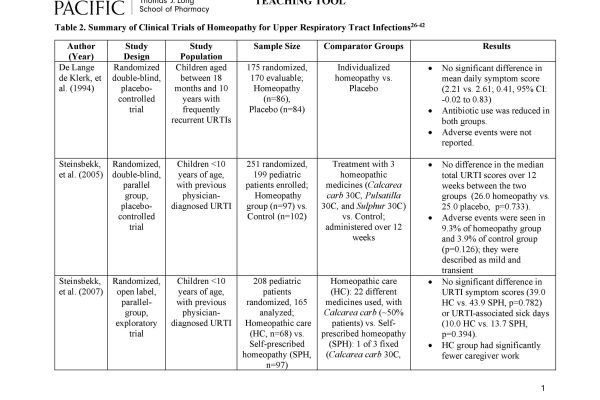
Existing evidence has investigated the application of homeopathic interventions across a range of URTI-related illnesses. Table 2 provides a sample of randomized clinical trials of homeopathic medicines in the treatment of URTI-related illnesses in adults and pediatrics.26-42
General Upper Respiratory Tract Infections
Zanasi et al. (2014) conducted a randomized, double-blind, placebo-controlled trial in 80 adults with acute cough due to upper respiratory tract infections or acute bronchitis.29 Participants were randomized to the homeopathic group, which consisted of a syrup (Anemone pulsatilla 6CH, Rumex crispus 6CH, Bryonia dioica 3CH, Ipecacuanha 3CH, Spongia tosta 3CH, Sticta pulmonaria 3CH, Antimonium tartaricum 6CH, Myocarde 6CH, Coccus cacti 3CH, Drosera MT) or placebo. The primary endpoint of cough severity was assessed using patient-reported, validated verbal category-descriptive (VCD) scores. After two days, both groups demonstrated statistically significant reductions in cough severity (homeopathy p=0.005 vs. placebo p=0.003), with no meaningful inter-group difference. As a secondary endpoint, mucus viscosity was evaluable in 53 of 80 participants with sufficient sputum samples. By day 4, sputum viscosity decreased in both groups. However, the homeopathic group demonstrated greater fluidity (p=0.018) and a larger absolute reduction in viscosity (-4.50±3.99 vs. –2.48±3.10); though the inter-group difference did not reach statistical significance (p=0.092).29
van Haselen et al. (2016) conducted a randomized, multicenter, controlled clinical trial in which 261 children under 12 years of age with acute URTIs and fever were assigned to receive either standard treatment alone (ST; n=131) or the same standard treatment plus Influcid (IFC; n=130), a combination homeopathic tablet containing Aconitum D3, Bryonia D2, Eupatorium perfoliatum D1, Gelsemium D3, Ipecacuanha D3, and Phosphorus D5. The IFC group had significantly earlier time to symptom resolution (p=0.0001), significant improvements in global disease severity (IFC 541.0 vs. ST 836.0 p=0.0001), symptom score (IFC 245.0 vs. ST 358.5, p=0.0003), and quality-of-life score (IFC 303.0 vs. ST 471.5; p<0.0001). A total of 50 single adverse events were observed; 14% IFC vs. 12% ST, but none were serious. One adverse event of vomiting was reported, potentially related to IFC.31 Of note, the D scale represents the decimal of 1:10 dilution similar to the X scale.31
Jong et al. (2016) conducted a randomized, open, controlled clinical trial in 200 children (ITT) comparing CalSuli-4-02 (Calcium carbonicum Hahnemanni D6, Calcium fluoratum D6, Calcium phosphoricum D6, and Sulfur jodatum D12; n=99) to a competitor homeopathic product (Gentiana D1, Aconitum D6, Bryonia D6, Ferrum phosphoricum D12, and Acidum sarcolacticum D12; n=101) for prevention of recurrent URTIs over 6 months.32 The primary outcome showed a slightly lower URTI risk in the CalSuli-4-02 group (RR=0.86), although not statistically significant (p=0.1099). Secondary outcomes significantly favored CalSuli-4-02, with higher odds of improved complaint severity (OR=1.99; p=0.0012) and symptom severity (OR=1.93; p=0.0033). Patient satisfaction was markedly higher in the CalSuli-4-02 group (58/99 vs. 21/101 “very satisfied”; p<0.0001). Antibiotic use decreased in both groups, and tolerability was favorable with few nonserious adverse reactions reported.32
Zabolotnyi et al. (2007) conducted a prospective, randomized, double-blind, placebo-controlled trial in adults with acute maxillary sinusitis, defined by having symptoms for 8 days or more and a Sinusitis Severity Score (SSS) of 12 or greater.35 A total of 113 patients were randomized to Sinfrontal (Cinnabaris D4, Ferrum phosphoricum D3, Mercurius solubilis D6; n=57) or placebo (n=56). At day 7, the Sinfrontal group showed a significantly greater reduction in SSS than placebo (−5.8 ± 2.3 points vs. −2.3 ± 1.8 points; p< 0.0001), meeting the primary outcome. Adverse events occurred more frequently with Sinfrontal (10.5%) than placebo (1.8%), though none were serious in either arm.35
Tonsillitis
Furuta et al. (2007) was a prospective, randomized, double-blind, placebo-controlled trial in which 40 children aged between 3 to 7 years with recurrent bacterial tonsillitis (5-7 episodes per year) with surgical indication were randomized to receive either individualized homeopathy (n=18) or placebo (n=15).36 The treatment group received an individualized constitutional medicine selected from Lycopodium, Pulsatilla, Lachesis, Belladonna, Nux vomica, or Phosphorous, plus Baryta carbonica 6CH, plus an isopathic medicine combination of ß-hemolytic Streptococcus, Staphylococcus aureus, Haemophilus influenzae and Tonsil, 12cH, administered over 4 months; and in the placebo group, all three components were replaced with placebo. Children receiving IHM had significantly less recurrence of tonsillitis symptoms than placebo (78% vs 33%; p=0.015). Children who experience acute bacterial tonsillitis were treated with antibiotics. At the end of the study, all cases that still had surgical indication were referred to surgery. No adverse events were reported in either group.36
Malapane et al. (2014) conducted a randomized, double-blind, placebo-controlled pilot study in children with acute viral tonsillitis.37 Thirty children aged ranging between 6 and 12 years were randomized to the treatment group to receive a combination of homeopathic complex (HC) of sublingual tablets containing Atropa belladonna D4, Calcarea phosphoricum D4, Hepar sulphuris D4, Kalium bichromicum D4, Kalium muriaticum D4, Mercurius protoiodid D10, and Mercurius biniodid D10 (n=15) or placebo (n=15). By day 6, pain scores dropped significantly more in the HC group (5.87±3.07 to 1.6±2.03) than placebo (6.40±2.4 to 5.2±3.0, p=0.001), with a large effect size (r = 0.8). No adverse events were reported in either group.37
Palm et al. (2017) was a randomized, open-label, parallel-group, controlled trial evaluating SilAtro-5-90 (Atropinum sulfuricum D5, Mercurius bijodatus D8, Hepar sulfuris D3, Kalium bichromicum D4, Silicea D2) as an add-on to standard care in patients aged between 6 to 60 years with recurrent tonsillitis.38 A total of 256 participants were randomized to SilAtro-5-90 plus standard treatment (n=132) or control group of standard treatment alone (n=124). The treatment group had a significantly lower risk of acute throat infections than control group (hazard ratio 0.45, 95% CI 0.297–0.683; p=0.0002), along with significantly less antibiotic use for these infections (37.0% vs 58.2%; p=0.0008). Three adverse events were reported in the SilAtro-5-90 group, including one withdrawal for severe gastroenteritis.38
COVID-19
Adler et al. (2022) conducted a randomized, double-bind, placebo-controlled trial in 86 adults with influenza-like symptoms and confirmed COVID-19. A total of 100 patients were randomized, with 86 cases deemed evaluable. Patients were randomized to the homeopathic Natrum muriaticum LM2 (n=42) or placebo (n=44).40 The primary endpoint of time to recover did not differ significantly between groups (p=0.56). However, the homeopathy group demonstrated a 50% reduction in symptom scores significantly earlier (p=0.04) than the placebo group. Three adverse events were reported in the homeopathy group (resulted in 2 discontinuations) compared to six in the placebo group.40 Of note, the LM potency represents the 1:50,000 dilution scale.
Kaur et al. (2023) was a single-blind, randomized, placebo-controlled trial of individualized homeopathy as an adjunct to standard care in 150 hospitalized adults with moderate-to-severe COVID-19.41 The add-on homeopathy (AoH) group achieved RT-PCR viral clearance significantly faster than placebo (7.53 vs 11.65 days, P<.001) and showed improved patient-reported outcomes and several inflammatory/coagulation biomarkers.41 The single-blind study design was a limitation, and results should be confirmed with double-blind trials.
Patient Care and Education
Pharmacists are clinically trained to evaluate self-limiting URTI symptoms and to distinguish between situations that are appropriate for self-care and those requiring referral for further medical evaluation. For patients who opt for CAM approaches, pharmacists can offer guidance when homeopathy may be a reasonable option and when it is not. Patients should understand that although homeopathic products may be used as complementary therapy for self-limiting conditions like the common cold, they are not FDA-evaluated for safety or efficacy in treatment of disease.13 Additionally, patients should avoid substituting products marketed as “homeopathic immunizations” for conventional vaccines, as the Center of Disease Control and Prevention indicates their effectiveness is not supported by reliable scientific evidence.12
Patient education should emphasize that homeopathic therapies must never delay or be substituted for necessary medical care. They should be instructed to stop use and contact their healthcare provider if symptoms do not improve or worsen, particularly in the presence of warning signs such as high or persistent fever, difficulty breathing, or symptoms that do not resolve within the typical course of a viral infection.
Individuals with a known allergy to any source ingredient in a homeopathic medicine should avoid that product entirely. Patients should be advised to inform their healthcare providers of all HDP use for potential drug interactions or toxicities. When selecting homeopathic products, consumers should confirm that the label includes the HPUS designation, assuring identity and quality standards.
Oftentimes the regimen on the label calls for frequent dosing, more often than pharmacy professionals may be used to seeing for other conventional medications. This can be a surprise and a reason for non-compliance and lack of effectiveness. Patients should be counseled to follow manufacturer’s instructions.
Frequently Asked Questions
How should homeopathic medicines be taken? Patients should be counseled to follow the manufacturer’s instructions, which often call for more frequent dosing than pharmacy professionals typically see with conventional medications. This unexpected dosing frequency can lead to non-compliance and reduced effectiveness if not properly explained.
How should homeopathic medicines be stored? Homeopathic medicines should be stored according to the labeled directions, typically at controlled room temperature and not exposed to extreme heat.14 Patients should verify protective packaging is intact before use, keep products out of children’s reach, and avoid use past the labeled expiration date.
How much do homeopathic medicines cost? Homeopathic medicines are generally inexpensive relative to other self-care options. Single-ingredient products typically retail from $8 to $10, while branded or combination products range from $8 to $30.24,43
Can homeopathic products be used in children? Caregivers should follow age-specific label directions closely; pediatric formulations carry minimum-age thresholds. Pharmacists should also be aware that the FDA has issued safety communications about specific homeopathic medicines marketed for children, including teething tablets found to contain excessive amounts of Belladonna, reinforcing the importance of recommending products from manufacturers that comply with HPUS and current Good Manufacturing Practice (GMP) standards.43,44
Can homeopathic medicines be used during pregnancy or breastfeeding? Safety data in pregnancy and lactation are limited, and product labeling directs patients who are pregnant or breastfeeding to consult their healthcare provider before initiating any homeopathic medicine.43
What are combination homeopathic medicines in URTI? Combination products contain several homeopathic active ingredients in a single product formulation intended to provide multi-symptom relief across the different stages of a cold. These formulations simplify product selection for consumers who would otherwise need to match a single medicine to the primary symptom, and pharmacists can help patients interpret the labeled purpose of each ingredient.45,46
Online Resources
The internet has made information about homeopathy widely accessible. A 2025 KFF tracking poll found that just over half (55%) of U.S. adults use social media at least occasionally to find health information and advice and nearly two-thirds of American adults report using a mobile app for a health-related purpose within the past year.47,48 Pharmacy professionals can draw on reputable online resources to support point-of-care product selection and counseling on appropriate use for patients who choose homeopathic products for relief of URTI symptoms.
Homeopathic organizations offer online educational content, such as virtual webinars and digital materials, that are directed at both the public and healthcare practitioners. The National Center for Homeopathy hosts a “Find a Remedy” tool on its website to help users identify homeopathic options for a range of self-limiting conditions, including cough, cold, fever, flu, and headache.49 Manufacturer mobile apps can similarly assist consumers in matching symptoms to homeopathic products.50 Pharmacy professionals seeking to build foundational knowledge of homeopathy, or to explore focused topics such as its role in oncologic palliative care and pain conditions, can do so through pharmacy continuing education programs accredited by the Accreditation Council for Pharmacy Education (ACPE).51
Conclusion
As homeopathy continues to grow as a CAM option for URTI self-care, pharmacy professionals are well positioned to guide its appropriate use. This continuing education provides pharmacy professionals with the essential knowledge to address patients’ questions, support safe and appropriate use, and recognize when referral to a healthcare provider is needed.