

Breadcrumb
Academic innovation at SHS prepares practice-ready graduates
University of the Pacific’s School of Health Sciences (SHS) is committed to creating an academic environment that fosters innovation and reflects changes in real-world health care fields.
Across its ten departments, faculty are empowered to pursue effective teaching methods and implement cutting-edge technology, helping SHS maintain a competitive edge by keeping pace with the rapidly changing landscape of health sciences education. The focus on academic innovation at SHS is producing competitive, practice-ready graduates prepared to serve the community upon graduation.
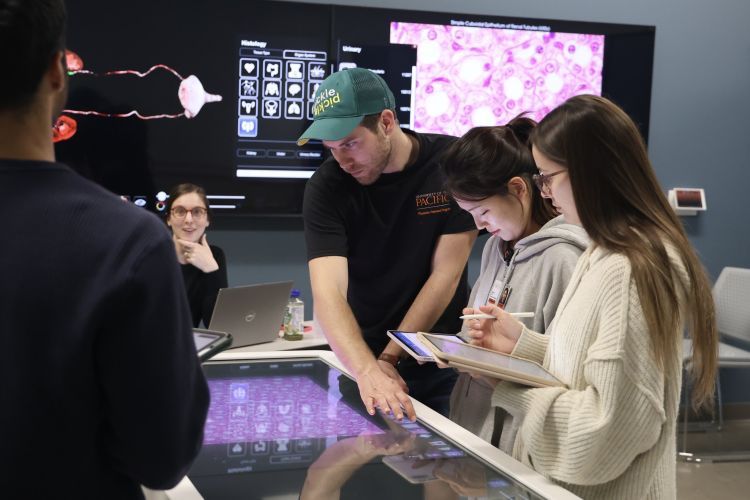
In 2024, the Physician Assistant (PA) Department integrated the Anatomage Table into its curriculum—a multi-touch screen with digitized human cadavers, medical learning tools and realistic 3D anatomical experiences. This technology serves as an advanced cutting-edge method for teaching students anatomy and physiology.
The table’s digital cadavers are based on real human bodies, allowing students to explore advanced anatomy and dissection labs in real time using a range of patient examples. Unlike a traditional cadaver lab, the table also lets students examine complex physiological processes, such as the stages of childbirth.
For the last two years, faculty from the PA Department have presented at the annual Anatomage conference. “This summer, I presented 'The Hormone Hunt: How to Turn Complex Systems into Engaging Table Games,' which combined use of the cadaver functions as well as a Jeopardy-style game all within the table,” says Assistant Clinical Professor and Clinical Director Dr. Kate Alibrando. The session focused on translating endocrine system functions into interactive table-game mechanics using the Anatomage Table to maximize student engagement in the classroom.
This year, the Speech-Language Pathology (SLP) Department is enhancing its curriculum and clinical experiences by adding Iowa Oral Performance Instrument (IOPI) devices, funded by a Technology in Education Committee Faculty Grant awarded to Assistant Professor Dr. Megan Black. IOPIs are medical devices that measure and improve tongue and lip strength, particularly for people with dysphagia (difficulty swallowing) and dysarthria (difficulty speaking).
One traditional method of treating dysphagia includes feeding the client modified food textures. If the wrong textures or food types are provided, the client could choke or aspirate. Because of this risk, students’ hands-on experience with clients who have dysphagia was limited. With the addition of the IOPI devices, students can now work with this patient population.
“We currently have a client who has been looking for providers in the area to help with some of these difficulties, but resources have been limited,” says Dr. Black. “I’m hoping that with this new technology we can expand the opportunities our students have for learning about different areas of the field and help provide another service option to the community.”
Next year, the Athletic Training Department will enhance its curriculum thanks to the new, state-of-the-art Student-Athlete and Sports Medicine Center. Located adjacent to the Alex G. Spanos Center on the Stockton Campus, this facility will be nearly three times larger than the former facility and will contain dedicated medical evaluation and functional rehabilitation spaces, three aquatic therapy pools, underwater treadmill capabilities and expanded treatment and rehabilitation technology. The center will create more opportunities for interprofessional collaboration within an NCAA Division I sports medicine environment by allowing students to work alongside athletic trainers, physicians, rehabilitation and performance professionals, and other SHS disciplines, enhancing their skills in patient-centered care.
“The center will elevate our students’ education by strengthening not only their technical skills, but also the areas employers are really looking for—clinical reasoning, communication, collaboration and evidence-based decision-making,” says Coordinator of Clinical Education and Assistant Clinical Professor Dr. Manuel Romero. “Those experiences will better prepare them to step into practice and contribute as part of a multidisciplinary health care team.”
By keeping up with current, emerging and future technologies, SHS stays at the forefront of academic innovation. Throughout their time at SHS, students gain the knowledge and insights that prepare them to evaluate, embrace and incorporate emerging technology into their professional practice.
Learn more about academic innovation at SHS.