

Breadcrumb
Students help shape new law enforcing California’s pay data reporting
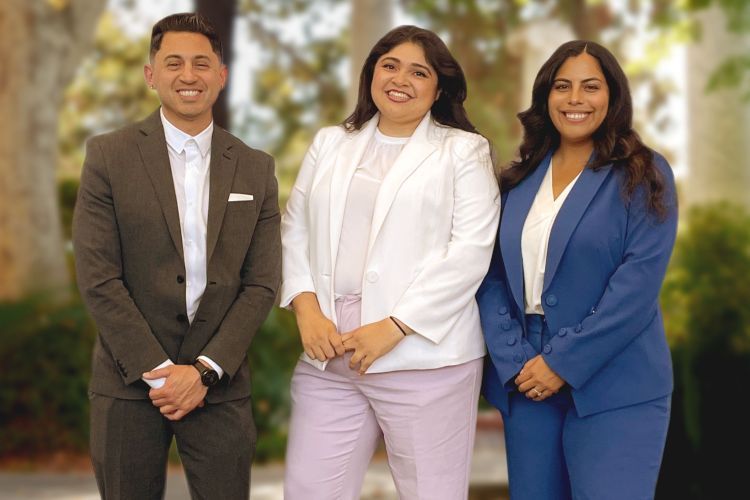
Three recent graduates from the University of the Pacific McGeorge School of Law saw a classroom idea become state law in September, after Gov. Gavin Newsom signed legislation they helped craft through the law school’s Legislative and Public Policy Clinic.
The new law increases transparency and accountability around pay data, strengthening efforts to identify and address wage disparities across California. Emy Quevedo ’26, Neda Pourhassan ’26 and Justin Breen ’26 worked on the legislation.
“What began as a labor of love among law students passionate about workers’ rights became an incredible opportunity to help shape California law,” Quevedo said. “Through McGeorge’s Legislative and Public Policy Clinic, the guidance of Professor Aaron Brieno and the connections of McGeorge alumni, we gained firsthand experience navigating the legislative process and helped advance legislation strengthening employer accountability and pay transparency with the Civil Rights Department.”
Under California Senate Bill 1237, authored by Sen. Catherine Blakespear, the Civil Rights Department will increase the penalties for employers with 100 or more employees who repeatedly fail to submit required pay data reports from $200 to as much as $1,000 per employee. The bill will require the Civil Rights Department to annually publish the total number of reports submitted.
Quevedo, Pourhassan and Breen helped draft the bill under the supervision of clinic director Aaron Brieno ’14. Brieno is a lobbyist at Cruz Strategies, a government relations and public affairs firm.
“Seeing SB 1237 signed into law is a proud reminder of what law students can accomplish. I hope future McGeorge students have the audacity to see themselves not just studying the law, but shaping it,” Quevedo said.
Quevedo and Breen testified about their support of the bill at a California Senate Judiciary Committee meeting last spring.
“We are extremely proud of SB 1237 and are happy to be moving the law forward in the pay equity space,” Breen said. “Hopefully future McGeorge students can pick up where our bill left off and bend the law even more towards justice.”
Despite decades of equal pay legislation, Pourhassan said significant disparities remain and continued policy efforts are needed to advance pay equity.
"It's ridiculous that we're building on legislation that was supposed to resolve Equal Pay in 1963, but it shows how much important work there is to be done to remedy the constant inequity women face as workers in every field,” Pourhassan said.
Since the clinic began in 2013, students have worked on 16 bills that later became enacted into law.
Most recently, students worked on a 2021 first-in-the-nation bill requiring hospitals to allow the use of cannabis for pain relief for terminally ill patients, a 2022 bill that made English as a Second Language courses more financially accessible to immigrants, a 2024 bill that tackled California’s aging water infrastructure crisis and promoted environmental justice, and a 2025 bill allowing law students to receive financial compensation from an externship site while earning academic credit.
In addition to the Legislative and Public Policy Clinic, McGeorge operates six other legal clinics in Sacramento, including the Bankruptcy Clinic, Buccola Family Homeless Advocacy Clinic, Elder and Health Law Clinic, Federal Defender Clinic, Immigration Law Clinic and Prisoner Civil Rights Mediation Clinic.