



In most people’s minds, John Muir is most closely associated with Yosemite, a place he loved and worked all his life to protect. Fewer people know that Muir was the first to propose that his beloved valleys were carved by glaciers during ancient ice ages, and to gather scientific evidence that the glaciers in the Sierra above were still moving and cutting. Muir had a sense of place that included a dimension of “deep time.” That deep-time sense carried over to his love of big trees. Two of his favorites, the Giant Sequoia and Coast Redwood, are conifers—relatively ancient compared to other angiosperm trees like oaks and maples, but not as old as their evolutionary relatives in the Araucaria family. Muir saw his first living Araucarias in Australia and New Zealand on his round-the-world tour in 1904. In 1905, in the Petrified Forest in Arizona, he realized he was looking at the fossils of an ancient forest that was probably dominated by 200-million-year-old relatives of the living trees he had just seen: an Araucaria Forest in deep time. On his last international journey in 2011, Muir deliberately sought out the two species of Araucaria found in South America, Araucaria angustifolia in southern Brazil, and Araucaria araucana in the Andes of Chile. Using the notes and sketches in his journals, I have followed his footsteps to the places where he finally saw those species, over several trips to Chile beginning in 2012, and more recently to Brazil in 2026. Seeing the same places Muir saw—and maybe even some of the same individual trees—more than a century later evokes a sense of place embedded in the flow of time, ultimately reaching very deep.

Breadcrumb
Searching for Big Trees in Deep Time
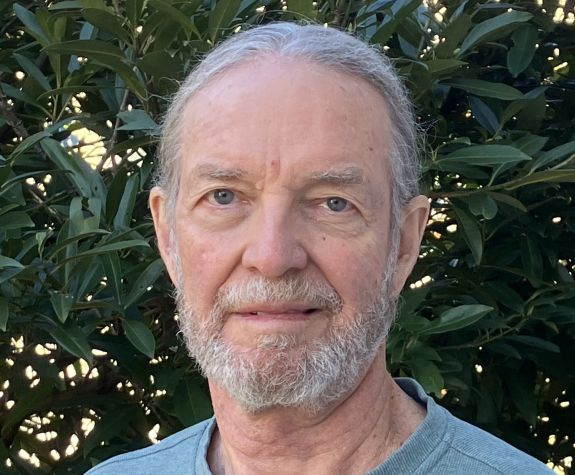
Dr. Bruce Byers is an ecologist, writer and international ecological consultant. His work aims to inform and inspire a more ecologically sustainable, equitable and resilient relationship between humans and the planet. Bruce has worked in more than 40 countries; his scientific publications and nonfiction writing about natural history, ecology, and conservation span decades. His book The View from Cascade Head: Lessons for the Biosphere from the Oregon Coast, a “biography” of the UNESCO Cascade Head Biosphere Reserve, was published by Oregon State University Press in 2020. His second book of creative nonfiction nature essays, Nature on the Edge: Lessons for the Biosphere from the California Coast, is a sequel focusing on California’s two coastal biosphere reserves, Golden Gate and Channel Islands (OSU Press, 2024). Bruce is currently working on a book about John Muir’s worldwide quest to see living members of the Araucariaceae.