

Breadcrumb
Pacific launches midwifery program to address statewide maternity needs
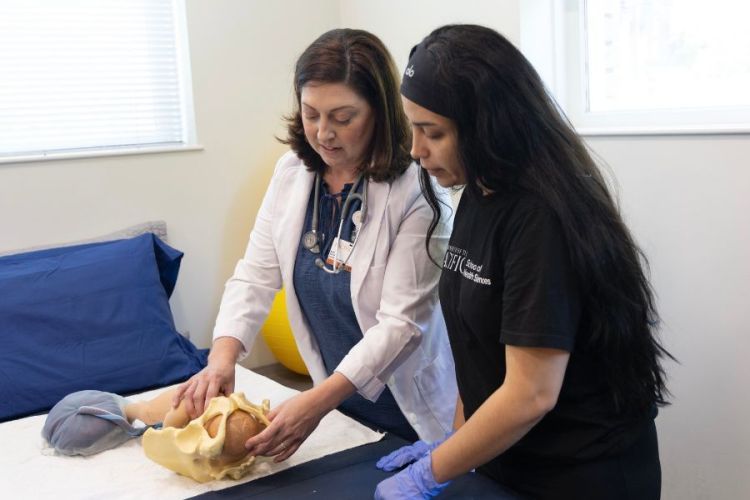
Midwifery Program Director Bethany Sasaki shows a demonstration to a student.
University of the Pacific is launching a Master of Science in Midwifery program designed to address California’s maternal health care shortages by preparing registered nurses to become certified nurse-midwives.
The clinical graduate program, based at Pacific’s Sacramento Campus, will prepare students to provide full-scope midwifery care, including prenatal, birth, postpartum and newborn care in homes, birth centers and hospitals. The program is only the second master’s-level midwifery program in California.
“We created this program because we're experiencing a huge maternal health crisis nationally and locally,” said Program Director Bethany Sasaki. “People are forced to choose between driving many hours in labor risking a birth en route, moving their whole family closer to a hospital in the last months of pregnancy, or delivering at home without a skilled attendant.
“Midwifery is the evidenced based best practice for perinatal care. We have decades of data to show that midwifery has better outcomes for low-risk women. Midwifery is also the best evidence-based response to the maternal health crisis. It has lower rates of cesareans, lower rates of complications and better breastfeeding rates,” she said.
The program will enroll students twice a year, in January and August, with cohorts of approximately 10 to 15 students.
Designed for working nurses, the hybrid program offers two- and three-year tracks. Students will attend classes one to two days a week, participate in simulation and hands-on laboratory experiences approximately once a month on the Sacramento Campus, and complete clinical hours one to two days a week at clinical sites throughout Northern California.
Pacific has established 36 clinical partner sites, including hospitals, birth centers and home-birth settings, allowing students to complete clinical training closer to where they live when possible.
“We are committed to recruit and train students from and for our communities, to increase access and health care delivery where it is needed most,” said Nicoleta Bugnariu, dean of the School of Health Sciences.
California has as many as 13 counties without obstetric services, creating what are known as maternity deserts: an area or county with no hospitals or birth centers offering obstetric care and no obstetric clinicians, such as OB/GYNs or certified nurse-midwives. In some areas, patients may travel as long as two hours to access maternity care.
"California continues to face significant maternal health disparities and a growing need for highly skilled maternity care providers,” said Nursing Department Chair Nassrine Noureddine. “This program builds on Pacific’s strength in health professions education while responding directly to the evolving health care needs of the communities we serve."
Midwifery is the newest addition to Pacific’s School of Health Sciences, which prepares new nurses, physician assistants, audiologists, physical therapists and other health care professionals for the workforce. Pacific’s broad health care portfolio also includes the Arthur A. Dugoni School of Dentistry, the Thomas J. Long School of Pharmacy and a forthcoming School of Medicine, which will prepare physicians to serve communities facing severe shortages of doctors across the Central Valley.
"University of Pacific’s Master of Science in Midwifery program is developing the next generation of certified nurse midwives. This program will help to expand access to high-quality maternity care, address workforce shortages, and support equitable access to care for growing and diverse populations,” Pacific Regent and Senior Vice President of Hospital System Operations at Kaiser Permanente Marty Ardron.
The new program embraces the Midwifery Model of Care, emphasizing informed choice, compassionate and individualized care, cultural humility, physiologic birth and partnership with individuals and families. It also focuses on health equity, reducing disparities and preparing graduates for collaborative practice, leadership, scholarship and policy engagement.
"Accreditation for University of the Pacific’s midwifery program is a foundational investment in the long-term well-being of our Stockton community," Central Valley Market President and President & CEO at St. Joseph's Medical Center David Ziolkowski said. "As we work to improve maternal health outcomes throughout greater San Joaquin County, having a world-class training program in our own backyard is a game-changer. We look forward to the profound impact these graduates will have on the families we serve."
In addition to core clinical education, students will receive additional training in mental health, lactation, ultrasound and entrepreneurship, equipping them with skills they can put to work immediately after graduation.
“They're going to have as much or more education than a board-certified lactation consultant. The additional training will prepare them to go out and open clinics and open practices. I want to flood the state with community-based midwives,” Sasaki said.
Applications are now open for the program’s inaugural January 2027 cohort.
Learn more about Pacific’s Master of Science in Midwifery program and how to apply.