

Breadcrumb
Pacific plans School of Medicine to address Central Valley physician shortages
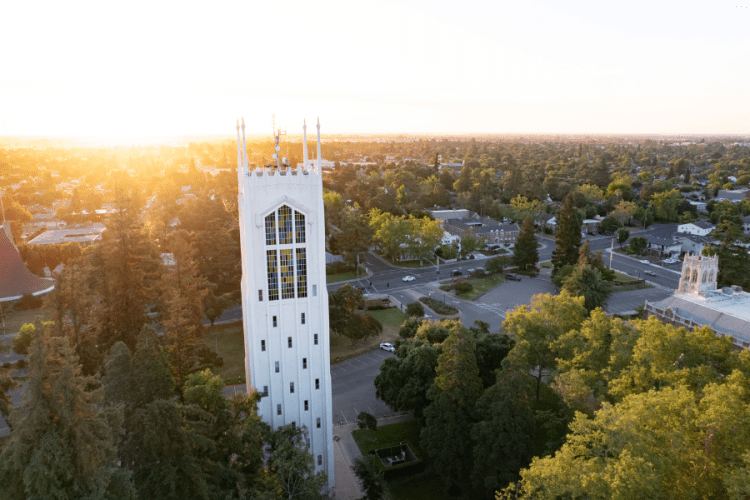
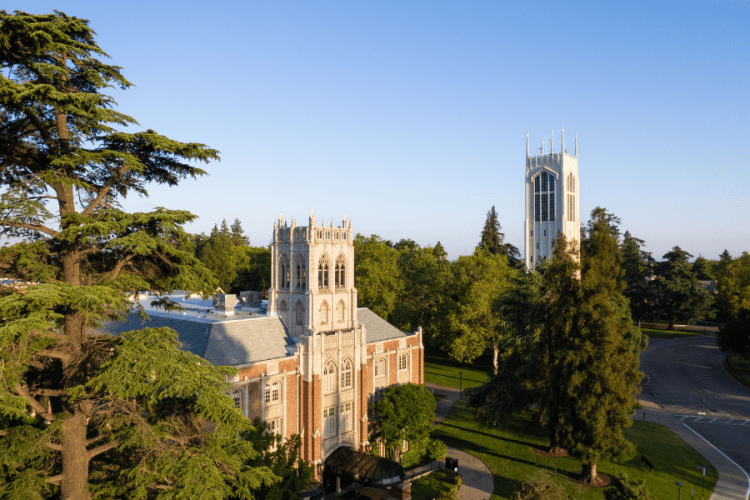
Burns Tower
University of the Pacific, founded 175 years ago as California’s first college, today unveiled plans to launch a School of Medicine, a transformational initiative to address the severe and growing physician shortages across the Central Valley and other areas facing dangerous health care disparities.
The Pacific School of Medicine will be California’s first M.D.-granting institution outside of the state’s largest population centers in Southern California, the Bay Area and Greater Sacramento.
Located on the university’s historic Stockton Campus, the new School of Medicine will focus on educating a new cadre of doctors for severely underserved areas. The regions located south of the Bay Area and Greater Sacramento and north of Los Angeles—the San Joaquin Valley, southern foothills, Central Coast and Eastern Sierra—all fall below the minimum standards for primary care physicians per capita while California’s largest metropolitan areas—home to the state’s 13 M.D.-granting schools—meet the recommended physician-to-population ratios.
The new School of Medicine will build on Pacific’s existing health care strengths from the Arthur A. Dugoni School of Dentistry, the Thomas J. Long School of Pharmacy and the School of Health Sciences, which prepares new nurses, physician assistants, audiologists, physical therapists and other health care professionals for the workforce.
Pacific will be just the 36th American university to have schools of medicine, dentistry, pharmacy and health sciences.
“We are enormously proud of our tradition of providing top quality educational opportunities for all qualified students—no matter their background or socioeconomic status—and creating hundreds of caring, practice-ready health care professionals each year who are desperately needed in our communities and beyond,” said Pacific President Christopher Callahan.
“The new School of Medicine aligns perfectly with our mission,” the president said. “We are not only ready, willing and able to tackle the dangerous and growing problem of the severe lack of physicians, but we believe it is our duty and responsibility.”
Gov. Gavin Newsom said today’s announcement “will be transformative for generations of Californians to come.”
“This brand-new University of the Pacific medical school opening near the heart of the Central Valley will create a critical pipeline bringing more physicians into our rural communities to serve and expand care for our state’s most vulnerable populations,” the governor said. “Now more than ever, investments like these in our higher education system create opportunities for empowering Californians to give back to their communities and build a healthier future across the Golden State.”
The Board of Regents, university leaders, private and government funders and health industry executives have been working behind-the-scenes for more than a year exploring the feasibility of a Pacific medical school. The Board voted unanimously May 15 to approve the new school.
“Our long history at Pacific is one of innovation,” said Board Chair Mary-Elizabeth Eberhardt. “We were the first college in California, created less than a year after statehood. We were California’s first coeducational institution of higher learning. We created the first conservatory of music west of the Mississippi. And 102 years ago, we moved the university from San Jose to Stockton to become the Central Valley’s first school to confer four-year degrees. But the School of Medicine might be our most important undertaking yet.”
Eberhardt noted that in 1858 Pacific created the first medical school in the American West, in San Francisco. It later became part of what is now the Stanford University School of Medicine.
An essential centerpiece of the new School of Medicine at Pacific is a strategic clinical partnership with Dignity Health St. Joseph’s Medical Center. Under the partnership, Dignity Health will place third- and fourth-year medical school students from Pacific in clinical rotations at St. Joseph’s and other hospitals across the region.
David Ziolkowski, president and CEO of Dignity Health St. Joseph’s Medical Center, worked closely with President Callahan to develop the strategic partnership.
Ziolkowski said the two institutions are “deeply committed to our shared values of excellence, inclusion, integrity, collaboration and humankindness, and are aligned in the urgent desire to address the region’s deep physician shortages.”
The physician shortage is worsening as nearly one in four California doctors is now 65 or older. While the state’s two largest population centers—the Bay Area and Southern California—have seen significant population declines over the past six years, the population in medically underserved regions are growing. San Joaquin County, for instance, increased by nearly 50,000 residents—second most in the state.
St. Joseph’s Medical Center, located less than two miles from the Pacific campus, is undergoing a massive expansion that will make it one of the largest hospitals in the state outside of the Bay Area and Southern California. That expansion is expected to be completed by 2030, which also is the scheduled opening of the School of Medicine if accreditation approvals are secured.
A global consulting firm conducting an in-depth feasibility study concluded that $150 million would be needed to create a financially self-sustaining medical school at Pacific. The estimate includes a 100,000-square-foot state-of-the-art medical education complex, simulation labs and other specialized equipment, and operational costs over the first decade.
The university secured more than $25 million from several major donors in advance of today’s announcement, including from Pacific Regent Tony Chan and his wife, former Regent Virginia Chan, both 1977 pharmacy school graduates, and the Stockton-based Cortopassi Family Foundation.
Tony Chan called the medical school “transformational for the future of the university and the health of our communities.”
“I started in this Valley pushing a mop. Because people believed in me, I’m standing here today,” Chan said. “This medical school is how we make sure the next kid mopping floors doesn’t have to leave the Valley to become a doctor. He or she can stay here. Learn here. Serve here.”
With today’s announcement, Pacific launched a public fundraising campaign to support the School of Medicine.
“This is a remarkable opportunity for Pacific to change the trajectory of our region," said Scott Biedermann '05, '20, vice president for development and alumni relations. “Opening a medical school is an ambitious undertaking, and its success requires robust community support. We are incredibly grateful to the Chans, the Cortopassis and all who have invested in the school thus far, and we look forward to welcoming more partners in this historic effort."
Legislators also have been actively pursuing funding for the new School of Medicine.
In the State Capitol, California State Assemblymember Rhodesia Ransom is pushing for a $50 million appropriation to help launch the school.
“California is facing a growing physician shortage, and families in San Joaquin County are already feeling it through longer wait times, fewer primary care options and the need to travel farther for care,” the state lawmaker said. “Pacific has long been a trusted institution in our region, and this new School of Medicine is exactly the kind of long-term investment we need to train homegrown doctors who understand our communities and are prepared to serve them. I am proud to push for state funding to help make this school a reality.”
State Sen. Jerry McNerney, who like Ransom represents San Joaquin County in the Statehouse, also is working on the state funding initiative.
McNerney called the Pacific School of Medicine “a pivotal step” toward “strengthening access to essential health care services in the region, especially in rural and underserved areas.”
In Washington, U.S. Rep. Josh Harder has been battling for federal funding that would cover the costs of the specialized equipment for the medical school.
“The Valley needs more doctors, nurses and health care workers—it’s that simple,” the congressman said. “Bringing the first medical school to the Valley is a huge step forward because it means training more doctors right here in our community. The people caring for Valley families should know this community, understand our challenges and be able to build their lives here, too.”
The School of Medicine also will have a major economic benefit for the region, generating more than $1.3 billion in economic output over the first decade, according to an analysis by the Center for Business and Policy Research at the Eberhardt School of Business.
Pacific will launch a national search this summer for the school’s founding dean.
Provost and Executive Vice President Gretchen Edwalds-Gilbert said the School of Medicine will draw on the many strengths of the university’s nine other schools and colleges and Pacific’s focus on interdisciplinary education and research.
“We have long been a leader in health science education, teaching our students to work across health professions while in training,” the provost said. “The medical program will build on our strengths in teaching and research, allowing us to offer new opportunities to our students and faculty while at the same time better serving the communities of the Central Valley.”
Pacific plans to design clear pathways to the M.D. program from a wide array of pre-med undergraduate degree programs. The university also plans on specialized pre-med tracks in the Pacific Summer High School Institute, a two-week residential program that serves about 1,800 high school students annually.
Over the past half-dozen years, during a time when many American universities have been struggling, Pacific has been on the rise by every measure, enjoying its highest enrollments, fundraising, research, financial strength and academic rankings in its 175-year history.
The Wall Street Journal ranks Pacific at No. 85 among all U.S. colleges and universities, and the university was named one of America’s 75 “Dream Schools” by author Jeff Selingo for exemplifying academic excellence, experiential learning, accessibility, affordability and exceptional student outcomes.
Pacific places a premium on the social mobility of its students.
The Georgetown University Center on Education and the Workforce rated Pacific first in the nation in career earnings among U.S. colleges and universities that have high percentages of Pell Grant recipients. Two of every five Pacific undergraduates receive Pell Grants, a federal program to support college students from low-income households. Half of the current first-year class identify as first-generation college students.
The New York Times ranked Pacific No. 23 in the nation among all colleges and universities—private and public—in economic diversity among students. Pacific is also the highest ranked U.S. university to have both Hispanic-Serving Institution and Asian American and Native American Pacific Islander-Serving Institution designations from the U.S. Department of Education.
The Carnegie Foundation for the Advancement of Teaching and the American Council on Education, in its first-ever measurement of alumni earnings and access to a college education no matter a student’s economic background, placed Pacific in the highest category—Higher Access, Higher Earnings.
“Pacific gave me more than an education,” said Board of Regents Vice Chair Leticia Robles, a 1989 Pacific alumna, a first-generation college graduate and the founder of Pacific Homecare Services, which now serves thousands of families across the region with in-home care for seniors and developmentally disable patients. “It gave me confidence. It gave me purpose. And it taught me that where you come from does not define how far you can go.”
“There are students sitting in classrooms across our region right now who dream of becoming physicians but wonder if there will ever be a place for them,” she said. “Today, Pacific is telling them: There is a place for you here. Your story matters. Your dreams matter. And your future matters.”
Pacific plans to welcome its first medical school cohort in Fall 2030, pending accreditation approval, with the school eventually growing to 400 students by 2037.