

Breadcrumb
President DeRosa’s lasting impact on Pacific Athletics
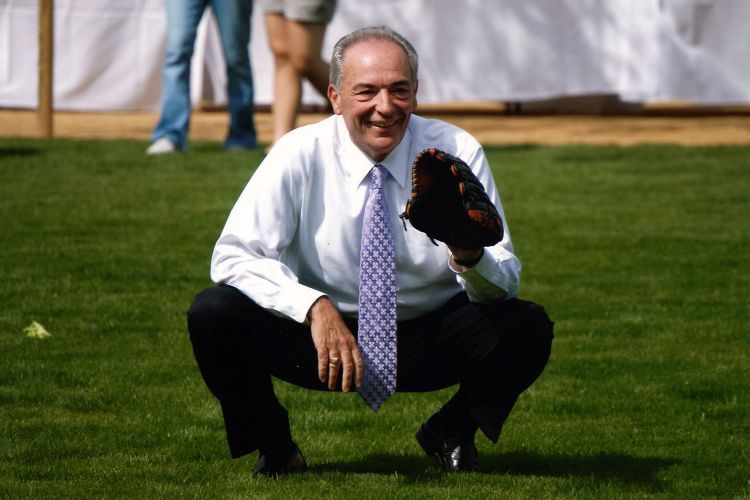
Don DeRosa playing catch on the lawn at the ribbon cutting ceremony for the Don and Karen DeRosa University Center in 2008.
As a first-generation college student who attended college on a baseball scholarship, Don DeRosa brought a deeply personal understanding of athletics to his presidency.
Growing up, he listened to the legendary Joe DiMaggio on the radio—an early connection that sparked both his love of the game and an appreciation for excellence in sport. As a pitcher on his college baseball team, he developed a mindset rooted in strategy and precision, learning how to make calculated decisions under pressure. Those instincts would later define his leadership style.
“During his presidency, Don DeRosa actively engaged with coaches and student-athletes to understand the significance of intercollegiate athletics and its role in fostering experiential learning and leadership development, which he identified as central to a Pacific education,” said Cindy Spiro '76, '84, who served as interim athletic director in 1996-97 and as senior associate athletic director under DeRosa. “His support greatly contributed to our numerous accomplishments in athletics during his tenure at Pacific.”
That engagement translated into visible momentum for Pacific Athletics. Under his presidency, five teams advanced to NCAA tournaments, including men’s basketball, women’s volleyball, men’s tennis, women’s swimming and softball.
He also led construction of signature athletic venues—Klein Family Field, the Intercollegiate Athletics Center, the Douglass M. Eberhardt Aquatics Center and the Janssen-Lagorio Gymnasium—and developed a relationship with the San Francisco 49ers to bring their training camp to the Stockton Campus.
Duane Isetti ’62, ’65, former head of the Pacific Athletic Foundation, described DeRosa as “a good man and a great president for athletics,” pointing to the 49ers partnership as one of his most impactful legacies.
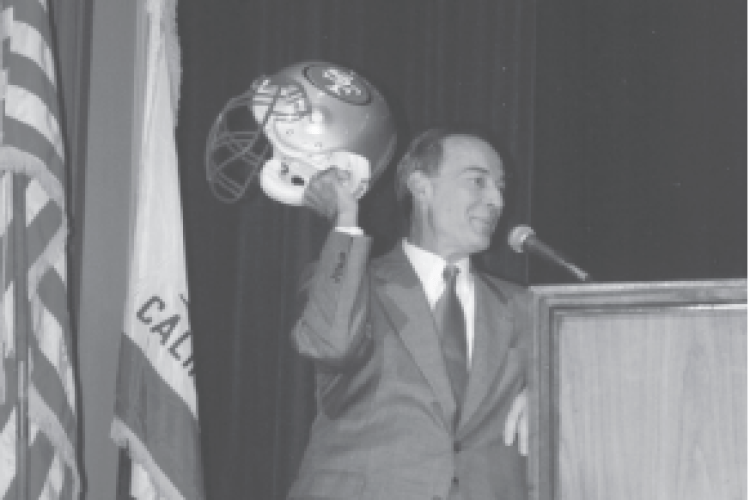
Former President Don DeRosa holds a 49ers helmet at the training camp announcement.
Before DeRosa brokered the deal, the 49ers had previously held its training camp at Sierra College in Rocklin. The team made the move to Pacific just three years after winning the Super Bowl for the fifth time in 1992, bringing hundreds of 49ers fans to campus daily during training camp as well as new facilities and revenue.
Led by a generous donation from alumnus Alex Spanos ’48, fans donated money to build the Pacific Intercollegiate Athletics Center to be used during training camp, the first new building under DeRosa’s presidency.
The building continues to serve as the central home of Pacific Athletics. In addition, annual payments from the 49ers contributed to funding upgrades to academic facilities and improvements to campus infrastructure.
“President DeRosa’s leadership laid a foundation that continues to benefit our student-athletes today,” said Director of Athletics Adam Tschuor. “His commitment to building a strong campus community and supporting the university’s growth helped elevate Pacific Athletics as part of the broader university experience. We’re grateful for the lasting impact he made on Pacific and the legacy he leaves for future generations.”
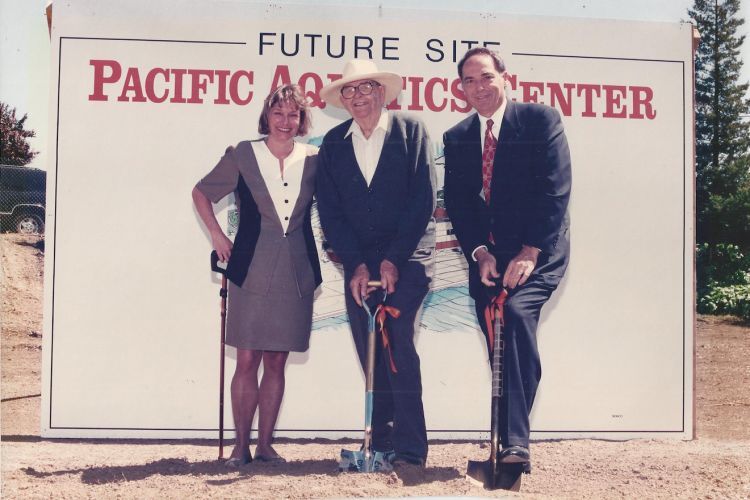
Cindy Spiro, Ted Baun and Don DeRosa break ground on the Pacific Aquatics Center, now named the Douglass Eberhardt Aquatics Center.
DeRosa also tackled athletic challenges during his presidency. Tiger football had served as a point of pride for the university and surrounding community since the move from San Jose to the Central Valley in 1924. But the financial realities of big-time college football led most universities like Pacific to eliminate their programs.
Pacific was no exception, experiencing significant annual operating deficits from its football program. DeRosa and the Board of Regents ultimately made the difficult decision to discontinue the sport, pointing out that by the 1990s only much larger private West Coast institutions—such as University of Southern California and Stanford University—continued to compete in Division I football.
Spiro remembers how DeRosa gracefully navigated folding the program.
“Don knew the difficulties the athletic department faced with this enormous loss to our program, and we worked together to refocus attention on our overall sports program and its positive impact on the Pacific experience,” she said. “He arranged for our coaches to have lunch with the regents, so they could learn about our sport programs and appreciate the academic quality of our student-athletes,” she said.
DeRosa worked to ensure Pacific sports would flourish, despite the setback of losing football. Freed from the program’s financial burden and guided by DeRosa’s strategic approach, Pacific Athletics entered a renaissance era from the early to mid-2000s. Resources were reallocated, fundraising accelerated and new facilities took shape.
“Don DeRosa had a fabulous professional demeanor, but he wanted to win,” said Ted Leland, former vice president of external relations and director of athletics at Pacific. “And that transferred into athletics. He knew how every team was doing. He came to games. He was a real catalyst for the program.”