Welcome to the Faculty Resources webpage. This site serves as a one-stop shop for dental faculty, offering a list of resources on a wide range of topics to support your teaching, research, and professional development.
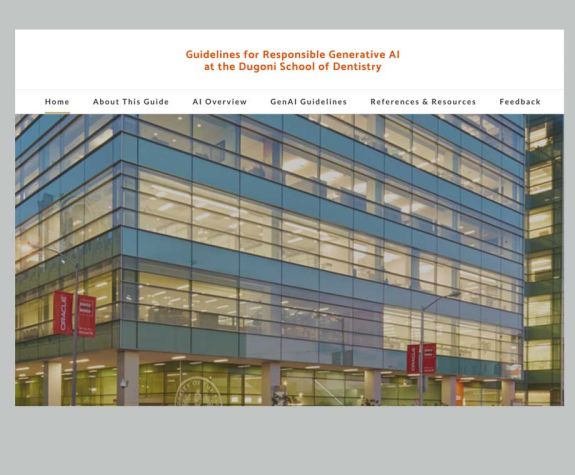
The Dugoni School has launched a new resource with guidelines to help faculty, staff, and students at the University of the Pacific, Arthur A. Dugoni School of Dentistry understand how to use generative AI effectively and responsibly.
For programs offered by the school that provide CDE credits, participants need to register here prior to the start of the program.
School Programs
- New Faculty Orientation: A presentation is given to new faculty that covers a wide range of information: administration, absences, clinical protocols. A new faculty information folder is shared via the Pac Manual Guidebook. They are given a tour and introduced to the faculty they will work with. A mentor is assigned for shadowing. They also receive their ID badges and set up their email etc.
- Cross Training: Held every quarter. Each week has a topic or subject and the presentation or hands-on events occurs each day of the week in an effort to reach all faculty. Week 3 of each quarter is faculty orientation week and week 10 is Grading week. These are not included in faculty cross training. Schedules are emailed to your Pacific email address and posted in 4F area.
- Dean's Speakers Series: The purpose of the Dean's Speaker Series is to increase the knowledge, skills, behavior and attitudes of our faculty, staff, students and alumni as it relates to an understanding of what is happening more broadly in health care, oral health care and education.
- Faculty Development Day(FDD): FDD is a quarterly event dedicated to the development of the dental faculty in areas of biomedical, research, clinical, trends in the industry as well as dental education. It occurs on Tuesday of final examination week.
- Biomedical Science Seminars: The seminars cover a wide range of topics in basic science and their application in dentistry. Scheduled are emailed to your Pacific address.
- Peer observation of teaching (POT): POT focuses on the strengths of the faculty member being observed, as well as on those areas that could be enhanced. Our primary goal is to provide formative feedback to support your teaching.
- Annual Teaching Showcase: This program provides a low-risk platform for faculty to demonstrate innovative instructional practices and exchange ideas. [In-person]
- Multi-institutional Dental Education Exchange (DEE): DEE is a multi-institutional group designed to strengthen our understanding of important issues in dental education and to collaborate with our colleagues in developing our skills as dental educators. Five dental schools joined to form the DEE, with one participating institution hosting a virtual (Zoom) session each year. Participating schools include University of Illinois-Chicago; University of Pittsburgh; Rutgers University; University of the Pacific; Boston University. [Zoom]
- Teaching & Assessment in Dental Education (TADE): This course, formerly the Course Director Orientation, is open to all Dugoni faculty. The course focused on evidence-based learning design and assessment principles. The course is self-paced and hosted on Canvas, the university's learning management system. It uses a flexible modular approach, allowing you to choose the modules aligning best with your interest and teaching needs. [Self-paced]
- Lunch and Learn Seminars: This program consists of a series of one hour seminars offered during lunch time. The focus is on active learning and emergent pedagogies associated with emerging technologies. [In-person]
For teaching development programs, contact Dr. Meixun Sinky Zheng (szheng@pacific.edu) for more details.
University Programs
Conferences
Dental education
Dentistry and science
- American Association for Dental, Oral and Craniofacial Research (AADOCR)
- International Association for Dental Research (IADR)
- Federation of American Societies for Experimental Biology (FASEB)
- American Association of Immunologists (AAI)
- American Society for Cell Biology (ASCB)
- American Society for Microbiology (ASM)
- Biophysical Society
General education
Seminars, webinars, and workshops
General Teaching Resources
Dugoni School Resources
These resources were developed in-house at the Dugoni School to help faculty with course planning and design.
- Teaching and Assessment in Dental Education - Short Course. This self-paced online course provides a practical foundation in evidence-based educational design. The modules cover key aspects of course planning, including the backward approach to course and lesson design, writing meaningful learning objectives, applying best practices in assessment and exam-item writing, and using item-analysis data to strengthen teaching and assessment practices.
- Hosted on Canvas and open to all Dugoni faculty.
- For access or questions, contact: Dr. Meixun Sinky Zheng (szheng@pacific.edu).
- Course director 101 (video): This 8-minute animated video provides a brief overview of the course planning process. While the video will be most helpful for new course directors, more experienced course directors can also use it as a refresher. [A few minor updates: 2024]:
- Night clinics are 6:00 – 8: 30 pm.
- Week 11: 1 instructional day (Mon) + 1 study day (Tue) + 3 days of final exams (Wed-Fri).
- Introducing your course to students on Day 1 (video): Check out this video to see how our own Dr. Gitta Radjaeipour introduced her preclinical course to new D1 students on the first day of class. Dr. Radjaeipour's course introduction was clear, transparent, and tied nicely to comprehensive patient care.
- Dugoni syllabus template (word): The template specifies the major sections and information that should be included in a course syllabus. It includes a sample generative AI course policy and the APA format for citing generative AI tools. (Updated 05.2025)
- Dugoni Canvas template (website): The template specifies the minimum tools that need to be activated on a Canvas site. It was approved by the dental school's Curriculum Committee. Several examples of module organization are also provided. Click the link to self enroll on the Canvas template site (Pacific credentials required; updated 05.2025).
- Dugoni Canvas site and syllabus checklist (word): This rubric is for department chair or vice chair use in reviewing Canvas sites and syllabi. All Canvas sites and syllabi need to be approved by the department chair before publishing.
Learning Objectives
- Writing SMART learning objectives (University of Arizona)
- Bloom's taxonomy (Vanderbilt University)
- Bloom's taxonomy action verbs (University of Arkansas)
Educational Alignment
Backward Design
Universal Design for Learning (UDL)
- Universal Design for Learning (UDL):The UDL framework guides you to create a more inclusive learning environment.
Copyright and Fair Use
- Copyright basics: A guide on copyright and fair use for Pacific faculty developed by Pacific librarians.
- Creative Commons: Creative Commons is a non-profit organization which has developed and provided a set of public copyright licenses for authors to use when sharing their work with others.
Other resources
Please reach out to Dr. Sinky Zheng (szheng@pacific.edu) for any additional resources.
Question tagging
- Pacific Dugoni question tagging guidelines (Pacific Dugoni)
Item writing
- Guidelines for writing case-based MCQs (University of Utah)
- Writing good multiple choice questions (Vanderbilt University)
- National Board
Item analysis
- Item analysis (PDF; Pacific Dugoni)
Assessment techniques
- Classroom assessment techniques (CATS) (George Washington University)
- Classroom assessment techniques (Vanderbilt University)
- Concept maps (Carnegie Mellon University)
- Digital timelines (Vanderbilt University)
- Assessing group work (Carnegie Mellon University)
Formative assessment
Feedback giving
- 12 tips for giving meaningful feedback in clinical education (Medical Teacher Journal)
Rubrics
- Designing and using rubrics (Carnegie Mellon University)
Below is a list of available and recommended tools for teaching and learning. Contact Meixun Sinky Zheng, PhD, Office of Academic Affairs, for consultation.
(Note: * indicates that the Dugoni School has a license. Also be aware that some links are only available to the University of the Pacific community.)
- Zoom*: the university's virtual meeting system.
- Faculty resources
- Classroom 514 operating guide: Video tutorials created by IT (03/2026)
- Managing breakout groups (video)
- Conducting polls during meetings
- 10 tips for maximizing online learning with Zoom
- Faculty resources
- ExamSoft*: the school's secure computer-based testing system.
- Canvas*: the university's learning management system.
- Faculty tutorials (full guide; selected tutorials linked below)
- Poll Everywhere*: an audience response system to collect student responses instantly from any mobile device.
- Osmosis*: a learning platform that features animated videos and other resources on basic sciences, medical and dental topics. All D1 and DH students have complimentary access to Osmosis.
- Click here for videos that Dugoni faculty co-developed with Osmosis.
- VoiceThread*: a web-based tool that allows instructors to create interactive presentations and invite students to watch and make comments directly on the slides.
- Faculty resources
- SoftChalk*: a cloud-based e-learning design tool that allows instructors to create interactive lessons that integrate a variety of learning activities.
- Faculty resources
- Thinglink*: an authoring tool for creating immersive learning experiences (e.g., branching scenarios, virtual escape rooms, virtual realities, images/videos with interactive tags).
- AI-powered Thinglink scenario builder
- Medical virtual escape rooms in Thinglink
- Nursing virtual scenarios and escape rooms
- How to create a virtual escape room in ThingLink?
- Using Canva to create images for ThingLink activities
- Pano to 360º Photosphere Converter: Take a photo with your phone and convert it into a 360* photo.
- Nearpod *: an all-in-one platform that allows instructors to present, engage, and assess.
- Faculty resources
- ScreenPal: an easy-to-use screen capture tool to make video tutorials.
- Videoscribe: an easy-to-use tool to create animated videos.
- Powtoon: an easy-to-use tool to create animated videos.
- Doodly: an easy-to-use tool to create whiteboard animations.
- EdPuzzle: promote active video-based learning by adding time-stamped questions into the video.
- Jeopardylabs: a web-based tool to create jeopardy-style learning games.
- Mindmeister: a web-based tool for students to create concept maps.
- Quizlet: a tool for creating flash cards. Students can study the cards in different ways, including game play.
- Kahoot!: a free tool for mobile polling and learning games.
- Padlet: a free web-based whiteboard for reflection, brainstorming, and collecting feedback.
- Miro: A free virtual whiteboard for discussion, collaboration, and more.
- Mural: A free virtual whiteboard for discussion, collaboration, and more.
- Weebly: a web-hosting service featuring a drag-and-drop website builder. It can be used to create e-portfolios. Other alternatives: Yola; Google Sites.
- Bioart: To prepare figures for publication or slides for lectures.
San Francisco software
List of software and applications available on the San Francisco Campus (login required).
Contact Raybel Ramos, Associate Dean for Information Technology, for details.
University software
List of software and applications (design, reference management, statistics packages, and others) available at the university (login required).
Contact Raybel Ramos, Associate Dean for Information Technology, for details.
The CUBE
The CUBE, a technology-rich collaborative space in the university library, works with faculty, staff, and students to develop digital tools for teaching, learning, and research (e.g., 3D printing, AR, VR, drones, multimedia production). Contact: cube@pacific.edu
This page features resources to help you leverage generative AI (GenAI) for academic purposes. In addition, we will continue to provide ongoing professional development sessions, including seminars, workshops, and on-demand resources.
Dugoni School GenAI Guidelines
The Dugoni School has developed the Dugoni Guidelines for Responsible GenAI to support faculty, staff, students, and residents in using GenAI effectively and responsibly for teaching, learning, research, clinical care, and daily administrative work.
Note: All community members are expected to review the guidelines prior to using GenAI in their work. Faculty are also encouraged to remind students to review the guidelines to promote effective and responsible use. Those mentoring students or other trainees on research should review the guidelines with them.
(The guidelines were last updated: 03/20/2025)
More Resources
General resources
- Vanderbilt University Medical Center: VUMC Statement on the use of generative AI. VUMC policies prohibits the sharing of VUMC data of any kind with public-facing generative AI tools. This includes patient and clinical data (even if de-identified), research data, proprietary VUMC operational data, and any intellectual property owned by the university and its employees.
- University of South Florida: Copyright and GenAI. It discusses GenAI, copyright, and fair use, and highlights cases of infringement related to using web content to train AI models.
For research
- University of Michigan Institute for Data and AI in Society (MIDAS): GenAI research resources. It provides a collection of tutorials on how to use Gen for research purposes.
- University of South Florida: Publisher policies on GenAI: It provides examples of GenAI policies of major publishers such as Elsevier, Sage, Nature, PLOS ONE, and Taylor and Francis.
For teaching
- University of the Pacific: AI and pedagogy resources. This SharePoint site contains several documents developed by UoP's Center for Teaching & Learning, e.g., assignment redesign, syllabus language, and recommended readings. Pacific credential required.
For learning
- University of the Pacific library has developed a collection of resources for students.
- Artificial intelligence for students. This subject guide helps students and faculty better understand artificial intelligence and its use in academia.
Recommended readings
AI and HIPAA: A primer. A research paper discussing the impact and implications of AI on HIPAA.
Anthropic Education Report: How university students use Claude. Study showing how students use Claude.
Anthropic Education Report: How educators use Claude. Study showing how educators use Claude.
How people are using ChatGPT. A study conducted by OpenAI on different ways people are suing its chatbot ChatGPT.
OpenAI’s ChatGPT dominates personal uses, while Anthropic’s Claude has the edge in business, dueling usage studies show. A Fortune article reporting findings from two global studies by OpenAI and Anthropic, examining how people are using ChatGPT and Claude AI.
It’s Time to Pull the Plug on ChatGPT at Cal State. An Inside Higher Ed article on recent lawsuits showing that AI poses risk to students' mental health.
Ambient AI Scribes in Clinical Practice: A Randomized Trial. A randomized trial study by UCLA Health to evaluate and compare the effectiveness of two clinical AI scribes (AI-powered tools to record patient encounters and generate visit notes).
GenAI Tools
(Note: * Indicates that Pacific has an institutional license.)
- Co-pilot*: MicroSoft's chatbot; log in with Pacific credentials.
- Scopus AI*: GenAI for literature review that has been integrated into library databases; log in with Pacific credentials.
- ChatGPT: Chat, upload files, and perform data analysis.
- Claude.AI: Chat and upload files.
- ChatPDF: Upload pdf and ask questions about the content.
- Synthesia: Create videos with AI avatars and voiceovers.
- Heygen: Create videos with AI avatars and voiceovers.
- Canva AI: AI-powered tool for creating flyers, images, and various graphics.
- NotebookLM: Personalized AI research assistant powered by Google's Gemini AI model. It can summarize documents, answer questions about them, and host interactive discussions with two AI hosts. Free.
- OpenEvidence AI: AI tool for medical information.
- AI Xploria provides a full list of AI tools by category to explore. The list is updated regularly.
- ADEA teaching resources: resources on teaching, learning, assessment, competency-based education, and more. It includes MedEdPORTAL, a peer-reviewed publication with downloadable multimedia resources.
- ADEA eLearn: Live and on-demand learning resources on a variety of important topics impacting dental education.
- Educause: a non-profit organization dedicated to advancing higher education through technology integration.
- Chronicle of Higher Education: a leader in higher education journalism that provides news, advice, and insights to succeed in a rapidly changing educational landscape.
- Online Learning Consortium (OLC): a leading organization dedicated to the advancement of digital and online learning.
Instructional Approaches
Below are practical tips, best practices, and sample lessons organized by instructional approaches/context.
- Online course/module self-evaluation checklist (Dugoni School)
- The checklist was adapted from the Quality Matters (QM) online course self-review rubric, which has been widely adopted as the national standards in online learning.
- How to be a better online instructor? Advice Guide (The Chronicle of Higher Education)
- Blended and online learning (Vanderbilt University)
- Blended learning tool kit (University of Central Florida)
- ADA compliance for online courses
Examples: Online learning modules
- SoftChalk online lessons (Dugoni School)
- Voicethread online lesson
- Example 1: Virtual medical case discussion (01.06.2025)
- Effective educational video design (Vanderbilt University)
- Osmosis-style animated videos: Playlist (Co-developed by Dugoni School faculty and Osmosis)
Examples of multimedia materials developed by the Dugoni School's media design team
- "3-2-1" quick reflection The "3-2-1" strategy can be easily implemented in any learning setting to promote reflective learning. You can also use it to help students engage with the text and improve their comprehension of assigned texts/videos. This is a good starting point.
- Reflection Toolkit (University of Edinburgh).
- Teaching and scaffolding critical reflection (Slides; Dugoni School)
Gameplay is a great way to engage this generation of students. Below are a few free web tools to create game-based learning.
- Jeopardylabs Web-based jeopardy game that doesn't need a PowerPoint slide template. It has free and paid versions.
- Hot Potato Create interactive multiple-choice, short-answer, crossword, matching/ordering and flll in the gap activities. It is free.
- Quizlet Search for and create your own flash cards and games. It is free.
- The BDA (Before, During, and After treatment) model for critical thinking in clinical teaching (Dugoni School)
- How formative assessment can cultivate medical students' competencies? (NBME)
- How can guided reflection and feedback transform learners into empathetic and effective communicators? (NBME) (12.2024)
- Alliance for Clinical Education (ACE) webinar series
Data and Support
Educational and other outcome data and support that you can request for teaching, research, and administrative purposes.
Educational Data Support
From idea generation to data acquisition, data analysis (including statistics), data visualization, and reporting, we provide support to help you translate educational data into actions. Contact:
- Dr. Meixun Sinky Zheng: szheng@pacific.edu
Below are the types of educational outcome data that you can request for teaching, research, and administrative purposes. There might be other types of data that are not listed here. Please reach out - we might be able to work with you to collect/access the data.
Learning outcomes
- GPA and course grades
- ExamSoft longitudinal performance reports
- Integrated National Board Dental Exam (INBDE)
- ADEX (clinical licensure exam; Dr. Homer Asadi, Clinical Dean)
- Competency assessment performance (Dr. Homer Asadi, Clinical Dean)
Instructional effectiveness
- Student Rating of Instruction (SRI)
- Peer Observation of Teaching
Curriculum design
- Curriculum mapping reports
- Enrichment program outcomes
Curriculum feedback
- Annual ADEA Survey of Dental School Seniors
- Annual Alumni Survey
Digital Platform Analytics
Many of the learning technology platforms used at the dental school provide program, course, and student level usage data.
Educational Outcome Data Website
This website (on MyPacific) hosts all major types of school-level summary data and reports, designed to support internal review by school leadership. It is currently accessible to all department chairs, program directors, associate deans, and the dean. Log in with your Pacific credential.
Other Institutional Data
Pacific Dugoni's Outcomes Team maintains various types of other institutional outcome data, including clinical and operational data. For more information, contact:

- Dr. Eric Salmon: esalmon@pacific.edu
- Hanisha Pasupulate: hpasupulate@pacific.edu
Research & Scholarship
For support in biomedical and clinical research, contact the following individuals.
Dr. Didem Ozdemir Ozenen (dozdemirozenen@pacific.edu)
Associate Dean for Oral Health Education
Dr. Ozdemir Ozenen is Associate Dean for Oral Health Education at the Arthur Dugoni School of Dentistry. She earned her DDS degree and a PhD in Pediatric Dentistry from Istanbul University, and a second PhD in Medical Education from Marmara University. She conducted clinical research at the National Institute of Dental and Craniofacial Research (NIDCR) at the National Institutes of Health (NIH).
For support on educational research and scholarship of teaching and learning, contact:
Dr. Meixun Sinky Zheng (szheng@pacific.edu)
Director of Educational Innovation and Assessment
Dr. Zheng can provide support for the life cycle of educational research and scholarship of teaching and learning, from idea generation to data collection, data analysis, and presentation and manuscript development.
Educational Poster Template
Click here to access a template for educational research posters. It is focused on the organization, content, and key points to be covered in each section.
Note: You might modify the colors to match the look and feel of the Dugoni themed template below.
Educational Manuscript Template
Click here to access a template for full-length original research manuscripts. It provides a high-level structure for publishing original research, key points to be covered in each section, and tips on how to present research findings.
Journal of Dental Education (JDE) Short Papers
In addition to traditional full-length original research manuscripts, JDE also publishes 500-word short papers in the Advancing Through Innovation series. Below are some examples of published short papers by Dugoni faculty.
Other Resources
Design & Photo Poster Template
In an effort to ensure that all research posters produced at the Dugoni School have a standard, cohesive, branded look that identifies the work with the dental school, the Design and Photo Services Department has created two poster templates (one horizontal, one vertical) available for download here (Login with Pacific credentials required). Contact the Design and Photo Department.
Publish Open Access for Free
Pacific has access to agreements with Elsevier, Wiley, Springer Nature, and ACS Publications to allow Pacific corresponding authors to publish Open Access in many of their journals for free. Visit the library's Research Support Guide to view the list of journals covered.
Selected Journals
Dental and Medical Education Journals
- MedEdPortal
- Journal of Dental Education
- European Journal of Dental Education
- Advances in Health Sciences Education
- Teaching and Learning in Medicine
- The Clinical Teacher
- Medical Education
- Medical Education Online
- Journal of Continuing Education in the Health Professions
- Medical Teacher
- BMC Medical Education
- Academic Medicine
Basic Science Education Journals
- American Journal of Pharmaceutical Education
- Pharmacy Education
- Advances in Physiology Education
- CBE Life Science Education
- Anatomical Sciences Education
- Biochemistry and Molecular Biology Education
- Journal of Microbiology and Biology Education
General Educational Research Journals
- Tech Trends
- New Directions for Teaching and Learning
- Active Learning in Higher Education
- Innovative Higher Education
- Online Learning Journal
- Teaching in Higher Education
- Journal of Scholarship of Teaching and Learning
Other Journals
Oral Health is a peer-reviewed journal published by the Arthur A. Dugoni School of Dentistry, University of the Pacific. The journal publishes research across all areas of oral health, including education, research, and clinical practice. The journal is open access (free for all readers). But unlike most open access journals, it is also free for all authors.
Co-Editors-in-Chief:
Dr. Didem Ozenen, Associate Dean for Oral Health Education (dozdemirozenen@pacific.edu)
Dr. David Ojcius (dojcius@pacific.edu)
Internal funding
University funding
A variety of grants to support faculty teaching, research, and professional development. (PacificID login required).
Contact: Dr. Didem Ozenen, Associate Dean for Oral Health Education, dozdemirozenen@pacific.edu.
Dugoni grants
The grants support all types of research, including basic science, dental/clinical, and educational research. (PacificID login required).
Contact: Harmony Matshik Dakafay, Research Lab Manager, hmatshikdakafay@pacific.edu.
Byron J. Thayer Fund
Funds may be used to support a variety of programs and projects for the School of Dentistry.
Contact: Dr. Didem Ozenen, Associate Dean for Oral Health Education, dozdemirozenen@pacific.edu.
External funding
Dugoni Faculty Research Resources
Resources on grants, grant support, shared instruments and facilities, links to IRB Office and more.
Research Support Guide
The university library's research support guide webpage has information on citation management (e.g., RefWorks), finding and choosing journals, publishing open access for free, and more.
IRB Resources
Follow the steps outlined here (PDF) and below to submit your IRB application.
- Register and complete the CITI research ethics training: Social and Behavioral Research Basic OR the Biomedical Research Basic.
- If you have not completed a prior IRB application with the online system, first fill out the Cayuse Access Request Form.
- Submit your IRB application to the Cayuse online system. University network login required.
Visit the IRB page on MyPacific for more resources.
University IRB office: irb@pacific.edu
Pacific Dugoni IRB representatives: Drs. Didem Ozenen, Rebecca Moazzez, Cassio Silva.
This section features research highlights and publications by the dental school faculty, staff, and students. Contact: Dr. David Ojcius, Assistant Provost for Research, at dojcius@pacific.edu.
Other Resources
General resources
- Dossier orientation slides (05.2024)
- Interfolio/Faculty 180 Guide
- CV creation and maintenance presentation
- Tenure and promotion criteria
- Length of service requirement calculator
- Mission-focused faculty evaluation (MFFE; 11.2024). Available by request from your chair.
Dossier management support
- Nancy Nyguen (nnguyen4@pacific.edu), Faculty Affairs Specialist, may offer additional support as needed.
Student rating of instruction
For questions, contact Office of Academic Affairs: Karinne Patchett (kpatchett@pacific.edu); Dr. Meixun Sinky Zheng (szheng@pacific.edu)
Peer observation of teaching
For questions, contact Dr. Meixun Sinky Zheng (szheng@pacific.edu).
- Guidelines
- Peer observation forms
- Calibrated peer observers: Lory Laughter, Mustafa Radif, Homayon Asadi, Alan Gluskin, Terry Hoover, Gene LaBarre, Bernadette Fa, Mike Suh, Bina Surti, Parvati Iyer, Paul Subar, Rebecca Moazzez, Xiaoyuan Han, Austin Davies.
- Interested in serving as a peer observer? Reach out to your department chair and/or Dr. Meixun Sinky Zheng.
Promotion and tenure eligibility and review
Contact Dr. Didem Ozdemir Ozenen, Associate Dean for Oral Health Education, at dozdemirozenen@pacific.edu.
- Dental School Strategic Plan
- Purpose, Vision and Values
- Competency Statements
- Competency assessment guide (on My Pacific)
- PIP (Personalized Instruction Program) (under Helix Curriculum)
- Dugoni medical emergency response program overview
- ADEA membership application (Free through Dugoni affiliation)
- University library
- Dental school library
For other faculty resources, visit My Pacific's Academic Affairs/Registrar Office page.