

Breadcrumb
Pacific's HSI Movement
Dear Pacificans,
In 2024, University of the Pacific reached an important milestone when we became a federally designated Hispanic-Serving Institution. While that designation is based on enrollment, it represents something much deeper than a percentage. It reflects who we are becoming as a university and the communities we have the privilege, opportunity and responsibility to serve.
This fall, our community had the honor of welcoming Dr. Gina Ann Garcia, one of the nation's leading scholars on Hispanic-Serving Institutions, organizational transformation and equity-centered leadership in higher education. Throughout her residency at Pacific, Dr. Garcia engaged students, faculty, staff, academic leaders, and alumni in conversations that challenged us to think beyond federal designation and toward a more profound question:
What does it mean for Pacific to truly be Hispanic serving?
That question brought together a remarkable cross-section of our university community. Dr. Garcia met with academic deans, faculty members, administrative leaders, staff and student representatives from our first-generation programs, Community Involvement Program, multicultural Greek life organizations, Latinx heritage, culture and engagement group, Center for Identity and Inclusion, and members of the schools and colleges that comprise Pacific. Faculty and leaders from the Arthur A. Dugoni School of Dentistry, Benerd College, College of the Pacific, Conservatory of Music, Eberhardt School of Business, McGeorge School of Law, School of Engineering and Computer Science, School of Health Sciences, and the Thomas J. Long School of Pharmacy joined these conversations, reflecting the broad institutional commitment required for meaningful change.
Across these discussions, Dr. Garcia emphasized that becoming an HSI is not an endpoint but a beginning.
She challenged us to think critically about campus climate, organizational culture and the systems that shape student success.
She invited us to consider the processes of servingness that move institutions beyond enrollment statistics and toward intentional practices that support students' learning, belonging, well-being and achievement.
She spoke honestly about the realities of organizational change: the barriers that often emerge, the resistance institutions encounter and the importance of leaders who advance transformation from every level of an organization.
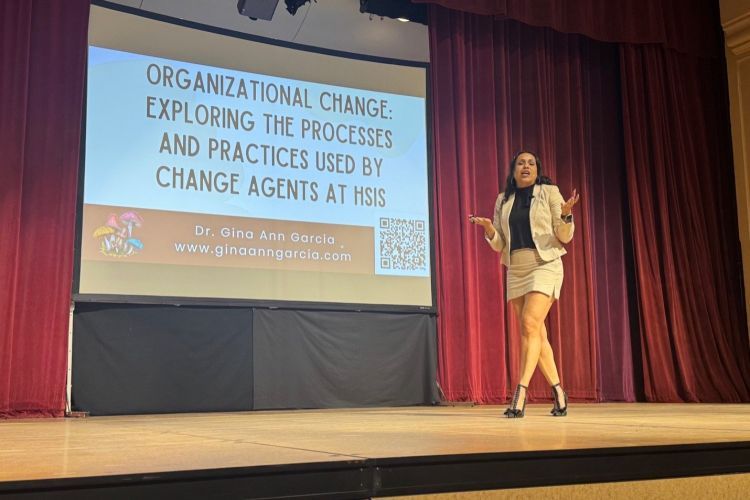
Dr. Gina Ann Garcia, Organizational Change: Exploring the Processes and Practices Used By Change Agents At HSIS
Perhaps most importantly, she encouraged us to envision a future in which Hispanic-Serving Institutions are not merely designated, but thriving.
This vision is especially important for Pacific. While many understand that an HSI designation begins when at least 25 percent of undergraduate students identify as Hispanic or Latine, servingness asks a different question. It asks not simply who is enrolled, but how an institution intentionally adapts its culture, practices, policies, and priorities to ensure students can flourish.
For Pacific, that work is neither temporary nor optional. The growth of our Latine student population across California and the nation continues to shape the students we welcome and educate. It is also an opportunity to deepen our understanding of students' identities, experiences, aspirations and strengths.
And the evidence is increasingly clear: when institutions better serve Latine students, all students benefit.
Dr. Garcia's work also reminds us that lasting change is not accomplished by a few individuals acting alone. It is created through collective effort, shared responsibility and a willingness to imagine new possibilities together.
One of the ideas that resonated deeply throughout her residency comes from adrienne maree brown's "Emergent Strategy: Shaping Change, Changing Worlds":
"Every member of the community holds pieces of the solution, even if we are all engaged in different layers of the work."
That insight feels particularly relevant to Pacific's HSI journey.
No single office, committee, program, or leader can create servingness on behalf of an entire institution. Rather, the work belongs to all of us. Every faculty member who creates an inclusive classroom. Every staff member who helps a student navigate an obstacle. Every administrator who examines policies and practices. Every student who shares their experiences and vision for a more welcoming community. Every alum who invests in the success of the next generation of Pacificans.
Each of us holds a piece of the solution.
As brown puts it, dreaming of new futures is itself a form of justice work. During her time at Pacific, Dr. Garcia invited our community to engage in that kind of dreaming. She asked us to imagine a future in which our HSI designation becomes more than a federal classification. She challenged us to see it as a catalyst for institutional transformation, an anchor for our strategic priorities and an expression of our deepest values.
What might Pacific look like if every student felt a profound sense of belonging?
What might be possible if our systems, structures, and practices more fully reflected the strengths and experiences of the communities we serve?
How might our teaching, research, mentorship, and partnerships evolve if servingness became a shared institutional commitment?
These questions do not have simple answers, nor will the path forward be linear. Meaningful change rarely is. It is iterative, adaptive and often decentralized. It emerges through relationships, experimentation, learning and reflection.
Yet this work aligns closely with who Pacific has always aspired to be.
For generations, our university has embraced the belief that diversity strengthens learning, expands possibility and prepares students to lead in an increasingly interconnected world. Our commitment to diversity, equity, inclusion, belonging and student success is an integral part of our HSI journey.
As we continue this work together, I encourage every member of our community to engage with Dr. Garcia's scholarship, particularly her newest book, "The HSI Movement." It offers not only a framework for understanding Hispanic-Serving Institutions, but also a compelling vision for organizational change rooted in equity, shared responsibility and institutional courage.
Pacific's HSI movement is not about reaching a number. It is about becoming the kind of university our students deserve: one in which excellence and inclusion are inseparable, and where servingness is the collective work of a community.
And ultimately, it is about believing that the future of Pacific will be shaped not only by what we aspire to become, but by what we choose to build together.
This dream belongs to all of us.
Please contact my office if you would like a copy of Dr. Garcia’s book.
With gratitude,
Mary J. Lomax-Ghirarduzzi
Vice President for Diversity, Equity, and Inclusion
Professor of Communication